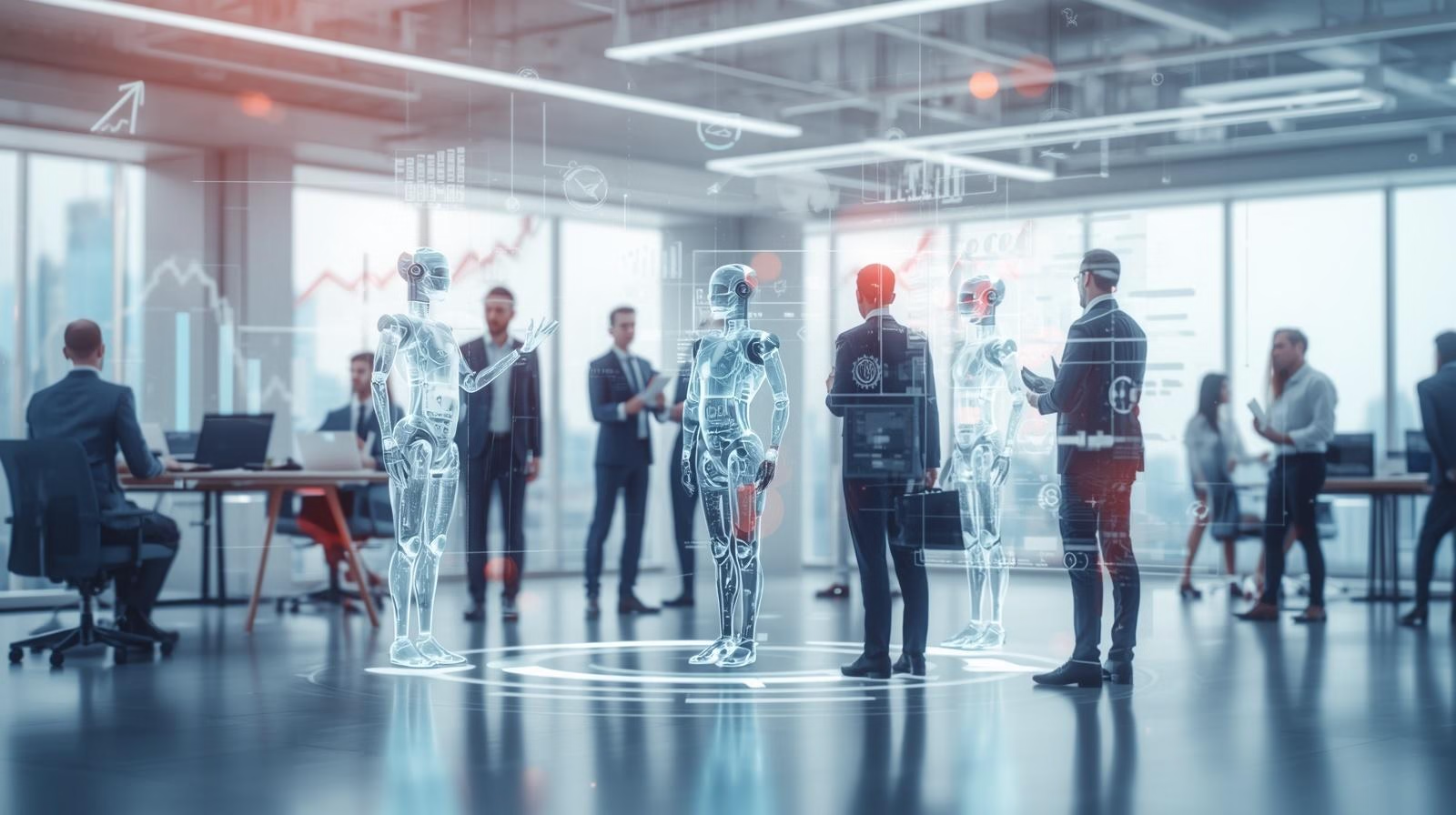

Companies are changing how they define “workforce” faster than most HR leaders thought they would. It’s not just workers who help with productivity anymore. AI systems now help with making choices, looking through job applications, answering customer questions, and looking at data. This change isn’t new. In many fields, it’s already a part of doing business every day.
This is exactly where HRTech is going: it’s becoming much more powerful than regular HR software. It is becoming the main system that controls how both people and AI do their jobs. McKinsey & Company says that by 2030, up to 30% of all work activities around the world could be automated. This would mean a big change in how businesses work. This means that HRTech is no longer a backend job. It is now a strategic engine that sets the level of productivity, scalability, and competitive advantage in the workforce.
HRTech manages both human and AI workers by giving them tasks based on their skills, keeping track of their performance with unified analytics, and letting AI and human decision-making systems work together. This one change is changing the way businesses grow and compete in the digital economy.
Contents
- 1 The Rise of the Hybrid Workforce
- 2 What AI Workers Actually Do in Organizations
- 3 Human vs AI Workforce Capabilities
- 4 How HRTech Allocates Work Between Humans and AI
- 5 Performance Management in a Hybrid Workforce
- 6 Real-World Example of Hybrid Workforce Execution
- 7 How Companies Actually Implement Hybrid Workforce Models
- 8 Data as the Backbone of Workforce Management
- 9 Challenges in Managing AI and Human Workers
- 10 Integration with Business Ecosystems
- 11 The Future of HRTech in AI Workforce Management
- 12 Common Questions Around Hybrid Workforce
- 13 Conclusion
The Rise of the Hybrid Workforce
The traditional way of working was based on people doing jobs, having set responsibilities, and doing things by hand. A hybrid workforce, where humans and AI systems work together in the same operational structure, is replacing that model today. This isn’t about getting rid of workers. It has to do with changing the way work is done.
AI systems are great at speed, consistency, and handling a lot of data, while people are great at being creative, having emotional intelligence, and thinking strategically. When these skills are used together in the right way, companies can get results that neither could get on their own. PwC did a study that found that more than 70% of executives think AI will greatly change the way businesses make money. This makes it even more important for HRTech platforms to become systems that can easily handle both types of contributors.
The hybrid workforce is not something that will happen in the future. It is already clear in automated hiring, AI-powered marketing systems, predictive analytics, and automated customer support. HRTech must now make sure that these systems are not working in isolation but are in line with how people work.
What AI Workers Actually Do in Organizations
AI workers, also known as digital employees or AI agents, are software-based systems that can do tasks on their own or with little help from people. These systems are built into business processes and are taking on more and more work that is repetitive, data-driven, and high-volume.
AI tools look at resumes, match candidates based on their skills, and guess how likely they are to get the job. Chatbots fix common problems right away in customer service, which cuts down on wait times and makes the customer experience better. AI improves marketing campaigns in real time based on how well they are doing. These apps show that AI is not just helping people; it is also taking part in the work that people do.
Gartner says that by 2026, more than 80% of businesses will have used AI-enabled apps. Because so many people are using them, HRTech systems need to change into platforms that can handle both AI workers and human employees.
Human vs AI Workforce Capabilities
The functionality of a hybrid workforce relies on the knowledge of the advantages and shortcomings of human beings and AI. The comparison below shows the differences between these two kinds of workers and their complementary nature.
| Capability Area | Human Workforce | AI Workforce |
|---|---|---|
| Decision Making | Contextual, emotional, strategic | Data-driven, rule-based |
| Speed | Moderate | Extremely fast |
| Scalability | Limited | Highly scalable |
| Creativity | High | Limited |
| Consistency | Variable | Highly consistent |
| Availability | Limited | 24/7 |
| Cost Structure | Recurring | Lower long-term cost |
This analogy explains why organizations do not have to make a choice between humans and AI. They are integrating the two to make maximum performance.
How HRTech Allocates Work Between Humans and AI
Choosing who will do what is one of the most important tasks that HRETech has to accomplish. It is no longer done on the basis of job roles but matching capability.
| Task Type | Assigned To | Reason for Allocation |
|---|---|---|
| Data Processing | AI | High speed and accuracy required |
| Strategic Planning | Human | Requires context and judgment |
| Basic Customer Queries | AI | Handles volume efficiently |
| Complex Customer Issues | Human | Requires empathy and problem-solving |
| Resume Screening | AI | Processes large datasets quickly |
| Final Hiring Decisions | Human | Requires cultural and strategic fit assessment |
This model will help in making sure that the human and AI workers work in their areas of expertise enhancing efficiency.
Performance Management in a Hybrid Workforce
To manage performance in a hybrid workforce, a single measurement system incorporating human and AI indicators is needed.
| Metric Type | Human Workers | AI Workers |
|---|---|---|
| Productivity | Tasks completed | Tasks processed per second |
| Accuracy | Output quality | Error rate |
| Efficiency | Time per task | Processing speed |
| Engagement | Satisfaction levels | System uptime |
| Learning | Skill development | Model improvement |
The integrated design enables HRTech systems to offer an entire picture of workforce performance, which can be utilized to make improved decisions.
Real-World Example of Hybrid Workforce Execution
An international corporation incorporated AI in its customer service system to respond to frequent queries. Over 60 percent of the requests were automatically processed by the AI system, and this reduced response time by a significant margin. Subsequently, human actors were able to prioritize more challenging issues, which pleased customers more and reduced burnout.
The AI systems are now able to sift through thousands of job applications within a few seconds and identify the most qualified applicants depending on their expertise and experience. Human recruiters then conduct the interviews and final decisions, ensuring that there is a balance between information and information and the human judgement.
These illustrations demonstrate how HRTech unites people and AI rather than separating them into two distinct entities.
How Companies Actually Implement Hybrid Workforce Models
Most organizations do not succeed in using AI tools because they do not implement them correctly in HR systems. The successful companies have a design strategy of implementation.
| Implementation Stage | What Happens | HRTech Role |
|---|---|---|
| Assessment | Identify tasks suitable for automation | Analyze workflows and capabilities |
| Integration | Deploy AI tools into workflows | Connect systems with HR platforms |
| Alignment | Define roles for humans and AI | Ensure task clarity |
| Monitoring | Track performance across both | Provide unified dashboards |
| Optimization | Improve efficiency based on data | Enable continuous improvement |
This organized implementation framework will ensure that the use of AI does not become chaotic and is oriented to business goals.
Data as the Backbone of Workforce Management
Data has the key role in handling hybrid workforces. The HRTech systems are systems based on data that help track performance, make predictions, and streamline workflows.
| Data Type | Purpose in HRTech |
|---|---|
| Employee Performance Data | Measure productivity and engagement |
| AI Metrics | Track accuracy and efficiency |
| Workflow Data | Identify bottlenecks |
| Skill Data | Match tasks to capabilities |
| Predictive Analytics | Forecast workforce trends |
According to IBM, organizations that leverage AI in workforce management can improve productivity by up to 40 percent. This highlights the importance of data-driven decision-making.
Challenges in Managing AI and Human Workers
HRTech needs to deal with the problems that come with managing a hybrid workforce, even though there are benefits. Holding people accountable becomes more difficult when AI systems are involved in making decisions. Organisations should establish transparent governance structures to ensure that all are accountable and transparent.
Another important thing is how much trust employees have in each other. People who work may be afraid that AI will take their jobs. HRTech needs to fix this by encouraging teamwork and making it clear that AI makes human work better, not worse.
Ethical issues are just as important. To avoid bias and make sure fairness, AI systems need to be watched. To deal with these risks effectively, HRTech platforms need to have ways to make sure they are following the rules.
Integration with Business Ecosystems
HRTech can’t work alone for companies like Arkentech. It needs to work with CRM systems, marketing platforms, and analytics dashboards. This integration makes sure that data about workers has a direct impact on business results.
For instance, connecting HRTech data with demand generation systems can show how the efficiency of the workforce affects lead generation. Connecting HRTech with analytics platforms also lets you see how well both people and AI are doing in real time.
This interconnected ecosystem turns HRTech into the organization’s main source of information.
The Future of HRTech in AI Workforce Management
The future of HRTech lies in its ability to orchestrate all types of workers through intelligent systems. Emerging trends indicate that AI will not only assist in workforce management but also manage other AI systems.
| Future Trend | Impact on HRTech |
|---|---|
| AI Managing AI | Automated system optimization |
| Skills-Based Workforce | Task allocation based on capabilities |
| Real-Time Analytics | Instant decision-making |
| Autonomous Workflows | Reduced manual intervention |
| Continuous Learning Systems | Ongoing improvement |
HRTech for AI and human workforce management is becoming the core system that defines how modern organizations operate, scale, and compete in the digital economy.
Common Questions Around Hybrid Workforce
A lot of the time, companies wonder if AI will take over people’s jobs. In reality, AI works with people, not instead of them. AI lets workers focus on strategic tasks by taking care of routine ones.
Another common worry is how to tell how well AI is working. HRTech systems fix this by keeping track of metrics for accuracy, efficiency, and reliability.
People are also becoming more interested in how workers can learn to work with AI. This necessitates training, skill enhancement, and a cultural transformation to foster collaboration between humans and machines.
Conclusion
AI is already changing how businesses work, so it is not something that will happen in the future. HRTech is at the heart of this change, making it easier for businesses to manage both AI and human workers.
HRTech makes sure that people and AI work together to reach business goals by aligning skills, using data, and making structured workflows. Companies that adopt this model will not only work more efficiently, but they will also have a big edge over their competitors in the changing digital economy.
HRTech will always be the link between human intelligence and machine capability, which will drive the next era of business performance as the workforce continues to change.