
Expectations from customer support have evolved a lot in the last few years. Regardless of whether people buy anything online, subscribe to a SaaS platform, travel or contact their banks, they expect immediate, personalized and accurate assistance. Long waiting times and repetitive interactions are no longer acceptable in this new digital era.
It is difficult for many organizations to live up to these expectations with their human customer support staffs alone. The cost of hiring extra personnel, providing 24/7 support, and dealing with repetitive questions can be prohibitive. And here comes the power of AI Customer Support Agents.
AI agents are not like traditional chatbots, which are scripted and keyword-based. Instead, they leverage cutting-edge technologies such as Natural Language Processing, Machine Learning and Large Language Models to understand what customers are looking for and respond appropriately.
In addition to answering questions, troubleshooting, making product recommendations, processing requests and transferring conversations to humans, these systems can do a whole lot of other things too. Businesses in the eCommerce, SaaS, healthcare, banking, insurance, telecoms, education and travel sectors are among many others who have realized the potential of AI customer support.
Beyond answering frequently asked questions, AI customer support agents can:
- Offer instant replies all day round
- Personalize each customer engagement
- Cut down support tickets
- Help live representatives during interactions
- Automate repetitive tasks
- Enhance customer satisfaction
- Gain customer insights
- Boost productivity
- Ensure consistency across channels
As Generative AI technology keeps developing, AI customer support is gaining importance as a business asset instead of a customer service one.
What Are AI Customer Support Agents?
AI Customer Support Agents are intelligent software applications that interact with customers Using natural language, they are able to comprehend user intention, understand the context, retrieve useful information, and respond in a meaningful way in real time.
Contrary to the old chatbot systems that could not be able to deal with questions outside the predetermined flow of conversation, the artificial intelligence system is able to understand the conversation language, recall past conversations and offer personalized service to the client.
Common integration platforms used by artificial intelligence agents include:
- Customer relationship management (CRM) software
- Help desk
- Knowledge base
- Order management software
- Billing software
- Product catalogs
- In-house documents
- Email support system
- Live chat software
Due to the above mentioned integration, AI agents can carry out real business activities and not just show predetermined answers.
For example, an AI agent can:
- Check order status
- Reset passwords
- Update customer information
- Schedule appointments
- Process refund requests
- Recommend products
- Verify account details
- Create support tickets
- Escalate complex cases to human representatives
The result is a faster, more efficient, and personalized customer experience.
How AI Customer Support Agents Work
Modern AI customer support combines several advanced technologies to understand customer questions and provide intelligent responses within seconds.
The process typically follows these steps:
Step 1: Customer Initiates a Conversation
A customer contacts support through channels such as:
- Website live chat
- Mobile application
- Facebook Messenger
- Voice assistant
- SMS
- Customer portal
Step 2: AI Understands Customer Intent
Using Natural Language Processing (NLP), the AI identifies what the customer wants, even if the wording is informal or conversational.
For example:
Customer: “I still haven’t received my package.”
The AI understands that the intent is order tracking, rather than focusing only on keywords like “package.”
Step 3: Information Retrieval
The AI securely retrieves information from connected business systems such as:
- CRM
- Order management software
- Inventory database
- Knowledge base
- Billing system
- Customer account records
Step 4: Response Generation
Using advanced language models, the AI generates a personalized response based on the retrieved information.
Example:
“Your order was shipped yesterday and is expected to arrive on Friday. Here is your tracking number.”
Step 5: Escalation if Required
If the request is too complex, the AI transfers the conversation to a human support representative while preserving the entire conversation history.
This eliminates the frustration of customers having to explain the same issue multiple times.
Core Technologies Behind AI Customer Support Agents
| Technology | Purpose |
|---|---|
| Natural Language Processing (NLP) | Understands customer language and intent |
| Machine Learning (ML) | Continuously improves response accuracy |
| Large Language Models (LLMs) | Generates natural, human-like conversations |
| Knowledge Base Integration | Retrieves business-specific information |
| CRM Integration | Personalizes customer interactions |
| Workflow Automation | Executes repetitive business tasks |
| Analytics Engine | Tracks customer behavior and support performance |
| API Integrations | Connects AI with business applications |
Together, these technologies enable AI customer support agents to provide intelligent, personalized, and scalable customer service.
Why Businesses Are Investing in AI Customer Support Agents
Customer service has become one of the most important factors influencing customer loyalty and brand reputation. Businesses that respond quickly and accurately are more likely to retain customers and build long-term relationships.
AI customer support agents help organizations meet these expectations while improving operational efficiency.
Faster Response Times
Customers no longer need to wait in long queues for simple questions. AI agents provide immediate assistance, reducing first-response times and improving overall customer satisfaction.
Reduced Operational Costs
AI automates repetitive inquiries, allowing support teams to focus on more complex customer issues. This helps businesses reduce staffing costs while maintaining high service quality.
Higher Customer Satisfaction
Quick, personalized, and accurate responses improve customer experiences and strengthen trust in the brand.
Scalability During High Demand
Whether a business receives hundreds or thousands of support requests, AI agents can manage multiple conversations simultaneously without compromising quality.
24/7 Customer Assistance
AI customer support remains available every hour of the day, ensuring customers receive assistance regardless of time zone or business hours.
Consistent Customer Experience
Unlike human agents, AI provides consistent responses that align with company policies, ensuring every customer receives accurate and standardized information.
Actionable Business Insights
AI analyzes customer conversations to identify:
- Frequently asked questions
- Product issues
- Customer sentiment
- Service bottlenecks
- Opportunities for process improvement
These insights help businesses continuously enhance their customer support strategies.
Key Features of Modern AI Customer Support Agents
Today’s AI customer support platforms offer capabilities far beyond basic chat functionality.
Intelligent Conversations
AI understands context, intent, and conversational language, allowing for more natural interactions.
Omnichannel Support
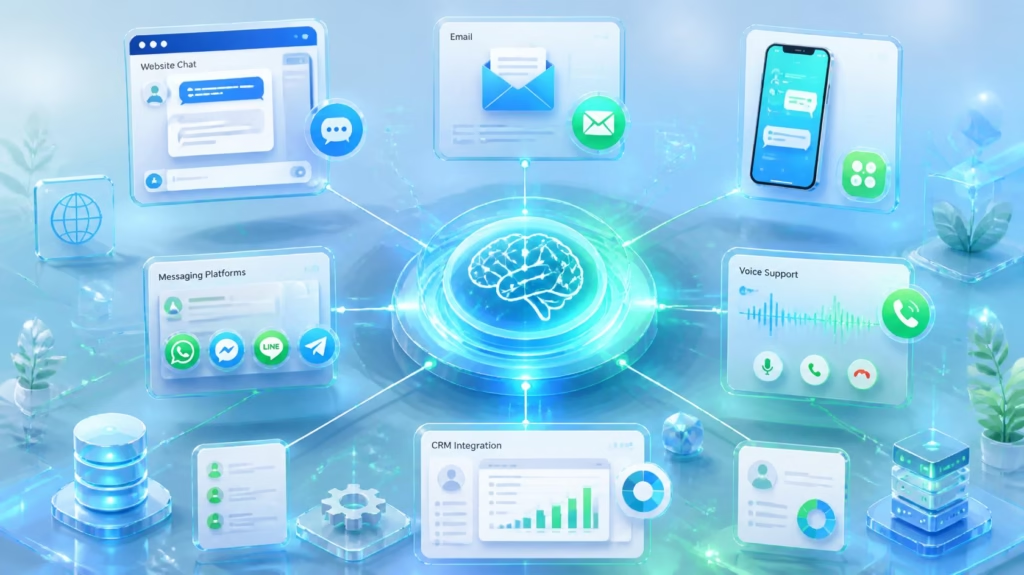
Customers can communicate using multiple channels, including:
- Website chat
- Mobile applications
- Facebook Messenger
- Slack
- Microsoft Teams
- Voice assistants
This ensures a seamless support experience across every touchpoint.
Context Awareness
AI remembers previous interactions and customer history, allowing conversations to continue naturally without requiring customers to repeat information.
Multilingual Support
Businesses can serve customers in multiple languages, making it easier to provide consistent support across global markets.
Workflow Automation
AI automates repetitive support tasks such as:
- Password resets
- Order tracking
- Appointment scheduling
- Subscription updates
- Refund requests
- Ticket creation
- Account verification
This improves efficiency while reducing manual workloads.
Smart Human Handoff
When an issue requires human expertise, AI transfers the conversation to a live agent along with all previous messages and customer information. This ensures a smooth transition and a better customer experience.
Analytics and Reporting
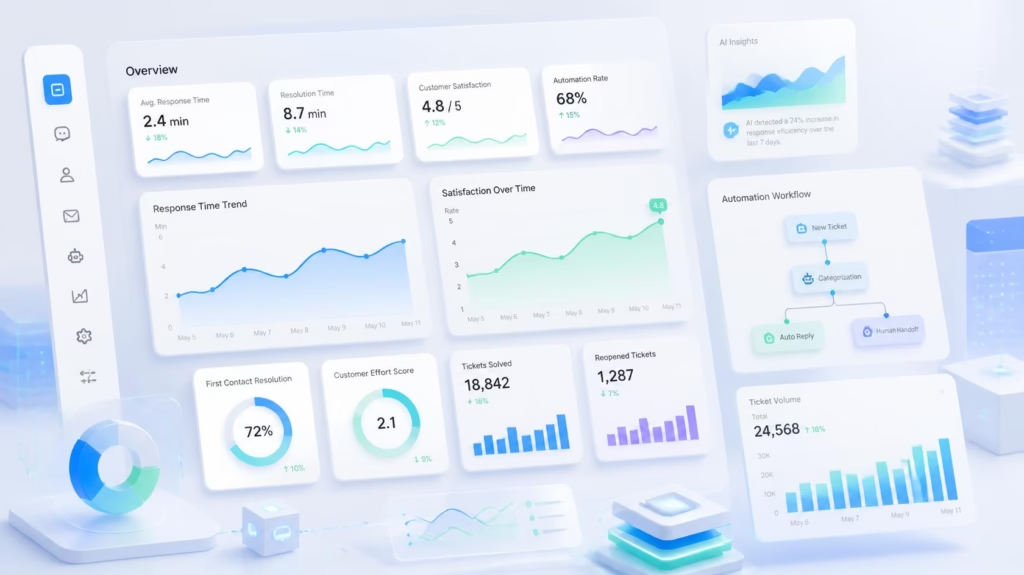
AI platforms provide valuable insights into customer service performance, including:
- Response times
- Resolution rates
- Customer satisfaction scores
- Common support topics
- Escalation trends
- Agent productivity
These analytics help businesses optimize their customer support operations and make data-driven decisions.
Industry Use Cases of AI Customer Support Agents
AI customer support agents are changing the landscape of customer service in all industries through instant response, cost savings, and better customer satisfaction. By being able to integrate into business processes, companies can automate mundane tasks while offering a personalized experience.
eCommerce
All eCommerce businesses deal with thousands of customers’ questions daily, related to order statuses, return/refund policies, payment methods, product availability, and more. The purpose of AI customer support agents is to make this interaction faster and more efficient.
Use cases:
- Order tracking
- Returns and refunds
- Recommendation engine
- Payment status
- Shipping info
- Product availability
- Coupon assistance
- Account management
Example: An online clothing store is using an AI chatbot for answering order-related questions 24/7, saving support tickets as it is answering the most frequent customer queries automatically.s.
SaaS Companies
Software companies rely heavily on customer support to improve product adoption and reduce customer churn.
AI customer support agents assist users by:
- Guiding new users during onboarding
- Explaining product features
- Resolving technical issues
- Managing subscriptions
- Answering billing questions
- Providing documentation links
- Collecting customer feedback
This allows customer success teams to focus on strategic customer relationships rather than repetitive support requests.
Banking and Financial Services
Banks and financial institutions use AI customer support to improve accessibility while maintaining secure customer interactions.
AI agents commonly handle:
- Account balance inquiries
- Transaction history
- Card activation
- Loan information
- Credit card support
- Fraud reporting
- Branch and ATM information
- Payment assistance
Sensitive or high-risk requests can be transferred directly to human advisors.
Healthcare
Healthcare providers use AI to simplify administrative tasks and improve patient communication.
Common applications include:
- Appointment scheduling
- Prescription refill reminders
- Insurance verification
- Clinic directions
- General health information
- Laboratory report updates
- Patient onboarding
This helps healthcare professionals spend more time on patient care instead of administrative work.
Travel and Hospitality
Travel businesses often experience seasonal spikes in customer inquiries. AI customer support agents help manage these fluctuations efficiently.
Common travel use cases include:
- Flight booking assistance
- Hotel reservations
- Travel itinerary updates
- Cancellation requests
- Refund status
- Visa information
- Travel policy guidance
Customers receive immediate support without waiting for an available representative.
Telecommunications
Telecom providers use AI to manage large volumes of customer requests.
Typical support includes:
- Mobile plan information
- Internet troubleshooting
- Bill explanations
- SIM activation
- Service outages
- Device support
- Upgrade recommendations
Automating these interactions improves response times while reducing pressure on call centers.
Education
Educational institutions and online learning platforms use AI to support students throughout their learning journey.
AI agents assist with:
- Admission inquiries
- Course recommendations
- Enrollment support
- Fee information
- Assignment deadlines
- Learning resources
- Student account management
Students receive faster responses, improving their overall learning experience.
Logistics and Supply Chain
Logistics companies use AI customer support agents to provide real-time shipment visibility.
AI helps customers by:
- Tracking shipments
- Checking delivery status
- Reporting delays
- Scheduling deliveries
- Managing pickup requests
- Updating delivery addresses
This improves transparency and reduces customer frustration.
Real Estate
Real estate businesses use AI to engage potential buyers and tenants more efficiently.
AI customer support agents can:
- Recommend properties
- Schedule property visits
- Share pricing information
- Answer mortgage-related questions
- Provide neighborhood details
- Capture buyer leads
This enables sales teams to focus on closing deals.
Major Benefits of AI Customer Support Agents
Businesses adopting AI customer support experience improvements in customer satisfaction, operational efficiency, and overall business performance.
Faster Response Times
AI agents provide immediate responses, eliminating long wait times and improving first-response metrics.
24/7 Customer Support
Unlike traditional support teams, AI agents remain available around the clock, ensuring customers receive assistance anytime.
Reduced Operational Costs
Automating repetitive customer inquiries allows businesses to reduce staffing costs while maintaining high-quality support.
Improved Customer Satisfaction
Quick, personalized, and accurate responses lead to better customer experiences and stronger brand loyalty.
Higher Agent Productivity
Human agents spend less time answering repetitive questions and more time solving complex customer issues.
Consistent Customer Experience
AI ensures every customer receives standardized and policy-compliant responses regardless of time or channel.
Easy Scalability
During peak business seasons, AI can manage thousands of simultaneous conversations without additional hiring.
Better Business Insights
AI analyzes customer conversations to identify:
- Frequently asked questions
- Product issues
- Customer sentiment
- Service bottlenecks
- Improvement opportunities
These insights support smarter business decisions.
AI Customer Support Agents vs Traditional Chatbots
| Feature | Traditional Chatbot | AI Customer Support Agent |
|---|---|---|
| Understands natural language | Limited | Advanced |
| Learns from conversations | No | Yes |
| Maintains conversation context | No | Yes |
| Personalized responses | Limited | Yes |
| CRM integration | Basic | Advanced |
| Handles complex questions | Limited | Yes |
| Supports multiple languages | Limited | Yes |
| Workflow automation | Basic | Advanced |
| Human-like conversations | No | Yes |
| Continuous learning | No | Yes |
Essential Features to Look For
Selecting the right AI customer support solution requires evaluating features that improve customer experiences and business efficiency.
Natural Language Understanding
The platform should accurately understand customer intent instead of relying solely on keywords.
CRM Integration
Connecting AI with CRM software enables personalized support using customer history and account information.
Knowledge Base Integration
AI should retrieve accurate information from:
- Help center articles
- Product documentation
- Company policies
- Internal resources
- FAQs
Omnichannel Support
Customers should receive consistent support across:
- Website chat
- Mobile apps
- Facebook Messenger
- Slack
- Microsoft Teams
Workflow Automation
The AI platform should automate repetitive tasks such as:
- Ticket creation
- Appointment scheduling
- Password resets
- Refund requests
- Subscription management
- Order tracking
Analytics Dashboard
Businesses should monitor performance metrics including:
- Response time
- Resolution rate
- Customer satisfaction
- Escalation rate
- Ticket volume
- Agent productivity
Human Handoff
The AI system should seamlessly transfer conversations to live agents while preserving the complete chat history and customer context.
Best Practices for Implementing AI Customer Support Agents
Successful implementation requires careful planning rather than simply deploying an AI chatbot.
Start with High-Volume Requests
Begin by automating common customer inquiries such as:
- Password resets
- Order tracking
- Shipping updates
- Billing questions
- Product availability
This delivers immediate efficiency gains.
Build a Comprehensive Knowledge Base
Ensure documentation is:
- Accurate
- Well-structured
- Regularly updated
- Easy to search
A strong knowledge base significantly improves AI response quality.
Train Your Support Team
Employees should understand:
- How AI supports daily operations
- When to intervene
- How to review AI-generated responses
- How to improve AI knowledge over time
Monitor Performance Regularly
Track important metrics such as:
- Customer satisfaction (CSAT)
- First response time
- Resolution rate
- Escalation frequency
- Ticket deflection rate
Regular analysis helps optimize AI performance and improve customer experiences.
Common Challenges of AI Customer Support Agents
While AI customer support agents offer significant advantages, businesses should understand the potential challenges before implementation. Identifying these issues early helps organizations build a more effective and reliable customer support strategy.
Handling Complex Customer Queries
AI performs exceptionally well with repetitive and structured questions, but highly technical, emotional, or unique issues may still require human expertise.
Best Practices
- Automate only routine support requests.
- Allow customers to connect with a live agent when necessary.
- Continuously train AI models using real customer conversations.
- Review unresolved queries to improve future responses.
Maintaining an Updated Knowledge Base
An AI customer support agent is only as effective as the information it can access. Outdated documentation can lead to inaccurate or misleading responses.
Best Practices
- Update FAQs regularly.
- Keep product documentation current.
- Remove outdated articles.
- Review policies whenever products or services change.
- Perform periodic knowledge base audits.
Customer Trust and Acceptance
Some customers may hesitate to interact with AI, especially when discussing sensitive topics such as payments, healthcare, or legal matters.
Businesses should be transparent about AI usage and provide customers with the option to speak to a human representative whenever needed.
Best Practices
- Clearly indicate when customers are chatting with AI.
- Offer a simple “Talk to a Human” option.
- Ensure AI responses remain professional and empathetic.
- Use AI to support—not replace—human interactions.
Integration with Existing Systems
Most businesses use multiple software platforms, including CRM systems, help desks, billing software, and eCommerce platforms. Poor integration can reduce AI effectiveness.
Best Practices
- Select AI platforms with strong API support.
- Test integrations before deployment.
- Synchronize customer data across connected systems.
- Monitor system performance regularly.
Maintaining Brand Voice
Customers expect consistent communication regardless of who—or what—is responding.
Businesses should train AI to follow brand-specific communication guidelines, ensuring responses match the organization’s tone and messaging.
Best Practices
- Create brand voice guidelines.
- Customize AI response templates.
- Review conversations periodically.
- Update prompts as business messaging evolves.
Security and Privacy Considerations
Customer support often involves sensitive information, making security a critical component of AI implementation.
Organizations should protect customer data by following industry-standard security practices.
Key Security Measures
- Encrypt customer conversations.
- Implement role-based access controls.
- Secure API connections.
- Monitor unusual account activity.
- Conduct regular security audits.
- Follow applicable privacy regulations.
- Obtain customer consent where required.
A secure AI support system helps build customer confidence while reducing compliance risks.
Measuring the ROI of AI Customer Support Agents
Businesses should define measurable goals before implementing AI and monitor performance using key customer service metrics.
Important KPIs
| KPI | Why It Matters |
|---|---|
| First Response Time | Measures how quickly customers receive assistance |
| Average Resolution Time | Indicates overall support efficiency |
| Customer Satisfaction (CSAT) | Evaluates customer experience |
| Net Promoter Score (NPS) | Measures customer loyalty |
| First Contact Resolution | Shows how often issues are resolved during the first interaction |
| Escalation Rate | Indicates the percentage of conversations transferred to human agents |
| Cost Per Ticket | Measures operational savings |
| Ticket Deflection Rate | Tracks how many inquiries AI resolves without human intervention |
Regularly reviewing these metrics helps businesses identify improvement opportunities and maximize their return on investment.
AI Customer Support Implementation Roadmap
Following a structured implementation process increases the likelihood of long-term success.
| Phase | Activities |
|---|---|
| Planning | Identify business goals, customer pain points, and automation opportunities |
| Platform Selection | Compare AI solutions and integration capabilities |
| Knowledge Base Preparation | Organize documentation, FAQs, and support resources |
| System Integration | Connect CRM, help desk, ERP, and business applications |
| Testing | Validate AI responses, workflows, and integrations |
| Employee Training | Train support teams to collaborate with AI |
| Deployment | Launch AI gradually and monitor customer feedback |
| Optimization | Continuously improve AI using analytics and customer interactions |
Future Trends in AI Customer Support
AI technology continues to evolve rapidly, introducing new capabilities that will further improve customer service.
Generative AI
Large Language Models (LLMs) can help build more context-aware and personal conversations between the AI and users, which would lead to improved support experience for the user.
Voice AI
The AI assistants are gaining capability to handle customer calls where they can engage in natural conversation and solve customer problems quickly.
Predictive Customer Support
The AI system would be able to track the customer behavior in advance to predict their future problems. This would help companies offer preemptive assistance to customers.
Hyper-Personalization
AI systems would use information about customer preferences, purchasing history, and behavior to create a highly personalized support experience for the customer.
Sentiment Analysis
AI systems would be capable of detecting customers’ emotional state in real-time, allowing for prioritizing certain conversations and responding to them in an empathic manner.
Multi-Agent AI System
Companies are adopting multi-agent AI systems that can perform various tasks related to support, such as billing, technical support, and customer success management.
Conclusion
The use of AI support representatives is revolutionizing the way companies interact with their clients as a result of fast response, personalized experience, and round-the-clock availability. From automation of repeated questions to increase efficiency, the use of AI technology has been a necessary part of customer service operations nowadays.
Nevertheless, there are more things to consider when implementing AI into your business. To make sure that your company gets full benefit from it, you will have to maintain a good knowledge base, proper system integration, adequate security measures, and monitor its performance.
Instead of substituting human support agents, AI is meant to complement them and help in increasing efficiency and working on more complicated tasks.
With continuous evolution of generative AI, voice AI, predictive analytics, and hyper-personalization, those who adopt AI customer support now will be able to provide superior customer experience, save money, and stay ahead of the competition in the future.
Frequently Asked Questions
What are AI customer support agents?
AI customer support agents are intelligent software systems that use artificial intelligence, natural language processing, and machine learning to answer customer questions, automate repetitive tasks, and provide personalized assistance across multiple communication channels.
How do AI customer support agents differ from traditional chatbots?
Traditional chatbots rely on predefined rules and keywords, while AI customer support agents understand context, learn from conversations, and generate more natural and accurate responses.
Can AI completely replace human customer support?
No. AI is highly effective for routine tasks and common inquiries, but human agents remain essential for handling complex, sensitive, or high-value customer interactions.
Which industries benefit most from AI customer support?
Industries such as eCommerce, SaaS, banking, healthcare, insurance, travel, telecommunications, logistics, education, and real estate all benefit from AI-powered customer support solutions.
Is AI customer support secure?
Yes. When implemented correctly, AI platforms use encryption, secure APIs, access controls, and compliance measures to protect customer data and maintain privacy.
How long does AI implementation take?
Implementation timelines vary depending on business size and system complexity. Small businesses may deploy AI in a few weeks, while enterprise implementations can take several months.
What should businesses consider before choosing an AI customer support platform?
Organizations should evaluate integration capabilities, scalability, security, analytics, multilingual support, workflow automation, and ease of deployment before selecting an AI solution.