

Artificial intelligence has moved beyond being an emerging technology it has become a practical business asset that helps organizations work faster, smarter, and more efficiently. Companies of every size are now investing in AI productivity tools for business to automate repetitive tasks, improve collaboration, support better decision-making, and help employees focus on meaningful work.
Instead of replacing employees, AI is empowering them. From intelligent assistants that organize schedules to AI-powered analytics that provide instant insights, these technologies enable teams to spend less time on administrative work and more time solving problems, serving customers, and driving innovation.
Businesses that successfully adopt AI productivity solutions often experience higher employee engagement, improved operational efficiency, reduced costs, and stronger overall performance. Whether you manage a startup, a growing business, or a large enterprise, understanding how AI can enhance workforce productivity is becoming essential for staying competitive.
In this guide, you’ll discover how AI productivity tools for business improve employee performance, the key benefits they deliver, and the best practices for implementing them successfully.

What Are AI Productivity Tools for Business?
AI productivity tools are software applications that use artificial intelligence, machine learning, automation, and natural language processing to simplify business operations and improve employee efficiency.
Unlike traditional software that relies solely on manual input, AI-powered tools continuously analyze data, recognize patterns, automate repetitive processes, and provide intelligent recommendations.
These tools assist employees with:
- Writing emails and reports
- Scheduling meetings
- Managing projects
- Organizing documents
- Creating presentations
- Data analysis
- Customer communication
- Task prioritization
- Workflow automation
- Knowledge management
The result is a more productive workforce that spends less time on repetitive administrative work and more time on strategic initiatives.
Why Employee Productivity Matters More Than Ever
Today’s workplaces face increasing pressure to deliver faster results while maintaining high-quality output. Employees often juggle multiple responsibilities, attend numerous meetings, and manage large volumes of information.
Common productivity challenges include:
| Workplace Challenge | Business Impact |
|---|---|
| Repetitive manual work | Lower efficiency |
| Too many meetings | Reduced focus time |
| Information overload | Poor decision-making |
| Administrative tasks | Employee burnout |
| Communication gaps | Project delays |
| Manual reporting | Lost productivity |
AI helps solve these problems by reducing routine work, improving collaboration, and providing instant access to valuable information.
How AI Productivity Tools Improve Employee Performance
Artificial intelligence enhances workplace productivity in several important ways.
1. Automating Repetitive Tasks
Employees spend hours every week performing repetitive administrative work such as:
- Data entry
- Invoice processing
- File organization
- Email responses
- Report generation
- Calendar management
AI automation completes these activities much faster, allowing employees to dedicate more time to high-value work such as innovation, customer engagement, and strategic planning.
Benefits
- Faster completion of tasks
- Reduced human errors
- Higher operational efficiency
- Better employee satisfaction
2. Smarter Time Management
One of the biggest productivity killers is poor time management.
AI-powered scheduling assistants automatically:
- Arrange meetings
- Prioritize daily tasks
- Recommend focus hours
- Reduce scheduling conflicts
- Send reminders
- Optimize calendars
Employees spend less time coordinating schedules and more time accomplishing meaningful work.
3. Better Decision-Making
Modern businesses generate enormous amounts of data.
AI productivity software analyzes this information within seconds and provides actionable recommendations.
Instead of manually reviewing spreadsheets, employees receive:
- Performance dashboards
- Sales forecasts
- Customer insights
- Productivity reports
- Risk analysis
- Trend predictions
This enables faster and more informed business decisions.
4. Improving Team Collaboration
Hybrid and remote work environments require seamless collaboration.
AI collaboration tools help employees by:
- Summarizing meetings
- Transcribing conversations
- Translating languages
- Organizing project updates
- Suggesting next actions
- Tracking deadlines
Teams stay aligned even when working across different locations and time zones.
5. Reducing Employee Burnout
Employee burnout often results from repetitive work, constant context switching, and administrative overload.
AI helps reduce these stressors by automating routine tasks and simplifying workflows.
Employees can then focus on activities that require creativity, problem-solving, and relationship building.
This leads to:
- Higher job satisfaction
- Increased motivation
- Better work-life balance
- Improved retention
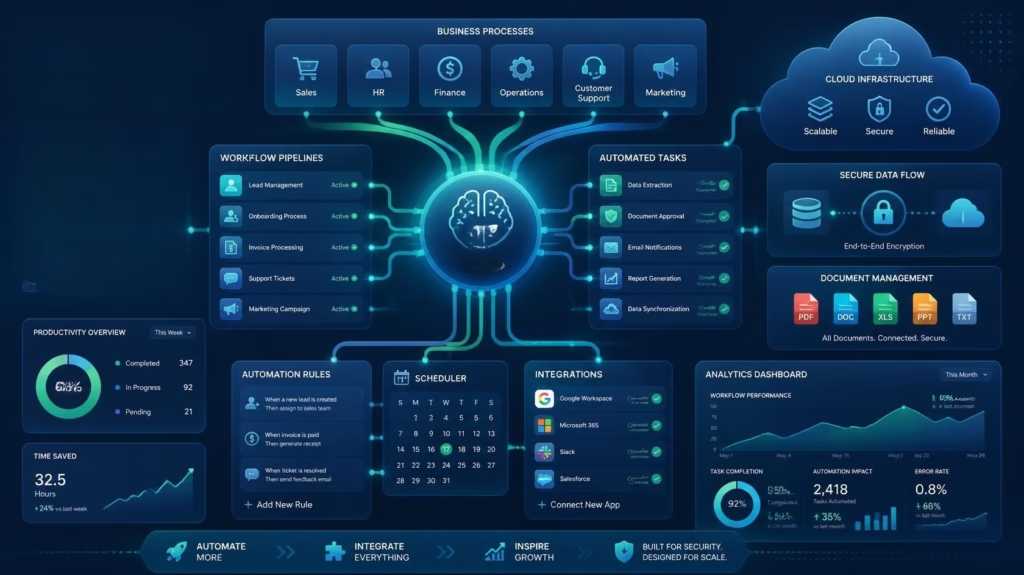
Key Benefits of AI Productivity Tools for Business
Increased Efficiency
AI dramatically reduces the time needed to complete everyday business tasks.
For example:
- Reports generated in minutes instead of hours
- Instant document searches
- Automated customer responses
- Faster project updates
The result is greater productivity across the organization.
Higher Work Quality
AI minimizes manual errors by:
- Validating information
- Detecting inconsistencies
- Suggesting corrections
- Standardizing documentation
Employees produce more accurate work with less effort.
Enhanced Employee Engagement
Employees prefer spending time on meaningful projects rather than repetitive administrative tasks.
AI enables them to:
- Develop new ideas
- Solve customer problems
- Learn new skills
- Collaborate effectively
- Contribute strategically
This improves both engagement and performance.
Faster Communication
AI-powered communication tools help teams by:
- Drafting emails
- Summarizing conversations
- Translating messages
- Prioritizing urgent communications
- Creating meeting notes automatically
Communication becomes clearer and significantly faster.
Business Departments That Benefit the Most
| Department | AI Productivity Benefits |
|---|---|
| Human Resources | Resume screening, onboarding, employee support |
| Marketing | Content creation, campaign analysis, SEO optimization |
| Sales | Lead scoring, email automation, forecasting |
| Customer Support | AI chatbots, ticket routing, knowledge management |
| Finance | Invoice automation, reporting, expense tracking |
| Operations | Workflow automation, inventory insights |
| IT | Help desk automation, system monitoring |
Traditional Productivity vs AI Productivity
| Traditional Workflow | AI-Powered Workflow |
|---|---|
| Manual reporting | Automated reports |
| Manual scheduling | Intelligent scheduling |
| Data entry | Automated processing |
| Spreadsheet analysis | Predictive analytics |
| Manual document search | AI-powered search |
| Long meetings | AI-generated summaries |
| Reactive decisions | Predictive recommendations |
10 Powerful Ways AI Productivity Tools for Business Improve Employee Performance
1. Automating Repetitive Tasks to Save Valuable Time
One of the biggest advantages of AI productivity tools for business is their ability to automate repetitive and time-consuming tasks. Employees often spend a significant portion of their workday entering data, organizing files, scheduling meetings, preparing reports, and responding to routine emails. These activities are necessary, but they don’t directly contribute to innovation or business growth.
AI-powered automation handles these repetitive processes quickly and accurately. Instead of manually sorting hundreds of emails or updating spreadsheets, employees can rely on AI to complete these tasks within seconds. This allows them to dedicate more time to strategic projects, creative thinking, customer engagement, and problem-solving. As a result, businesses experience improved efficiency while employees feel more productive and less overwhelmed by administrative work.
2. Enhancing Workplace Communication and Collaboration
Effective communication is essential for every successful organization, particularly as remote and hybrid work models become more common. AI productivity tools significantly improve collaboration by making information easier to access and reducing communication delays.
Modern AI solutions can automatically generate meeting summaries, transcribe conversations, organize action items, and even translate discussions between multilingual teams. Employees no longer need to spend valuable time taking notes during meetings or searching through lengthy email threads to find important information. Instead, AI provides organized, searchable records that help teams stay aligned and complete projects more efficiently. This creates a smoother workflow and encourages stronger collaboration across departments.
3. Helping Employees Prioritize Their Work
Managing multiple projects and deadlines can be challenging, especially when employees receive constant emails, messages, and meeting requests throughout the day. AI productivity software helps solve this problem by intelligently prioritizing tasks based on urgency, deadlines, workload, and business objectives.
Rather than relying solely on manually created to-do lists, employees receive personalized recommendations about which tasks should be completed first. AI continuously analyzes schedules and identifies opportunities to improve productivity by reducing unnecessary interruptions. This intelligent prioritization helps employees stay focused on high-impact work while minimizing stress and missed deadlines.
4. Accelerating Data Analysis and Decision-Making
Businesses generate vast amounts of information every day, including sales reports, customer feedback, financial data, website analytics, and operational metrics. Analyzing this information manually is often time-consuming and increases the risk of overlooking important trends.
AI productivity tools process large datasets within seconds and transform complex information into clear dashboards, charts, and actionable insights. Managers and employees can quickly identify performance trends, customer behavior, operational bottlenecks, and new business opportunities without spending hours reviewing spreadsheets. Faster access to reliable data enables organizations to make smarter decisions, respond quickly to market changes, and improve overall business performance.
5. Improving Content Creation Across Departments
Content creation is no longer limited to marketing teams. Human resources departments prepare training materials, sales teams write proposals, customer support agents create knowledge base articles, and executives develop business presentations. Producing high-quality content consistently requires considerable time and effort.
AI writing assistants help employees create first drafts for emails, reports, presentations, blog articles, meeting notes, and documentation within minutes. While human expertise remains essential for reviewing and refining the final content, AI dramatically speeds up the writing process by providing structure, suggestions, and relevant information. This allows employees to focus more on creativity, strategic messaging, and audience engagement.
6. Delivering Faster and More Personalized Customer Support
Customer expectations continue to rise, and businesses are expected to provide immediate responses across multiple communication channels. AI productivity tools help customer support teams manage growing workloads without compromising service quality.
AI-powered chatbots answer common customer questions instantly, while intelligent ticket routing ensures that complex issues reach the appropriate support specialists. AI can also summarize previous customer interactions, recommend accurate responses, and suggest relevant knowledge base articles. These capabilities reduce response times, improve first-contact resolution rates, and allow support teams to concentrate on solving more challenging customer problems.
7. Supporting Smarter Business Decisions
Successful organizations rely on accurate information to guide strategic decisions. AI productivity tools provide real-time insights that help leaders understand employee performance, customer behavior, operational efficiency, and financial trends more effectively.
Instead of waiting for manually prepared reports, decision-makers receive automated analytics that highlight opportunities and potential risks as they emerge. Predictive analytics can even forecast future demand, identify resource requirements, and recommend actions that improve business outcomes. Employees at every level gain access to reliable information that supports faster and more confident decision-making.
8. Reducing Errors and Improving Accuracy
Manual business processes inevitably lead to mistakes, especially when employees manage large volumes of repetitive work. Errors in financial reports, customer records, inventory data, or compliance documentation can result in costly consequences for organizations.
AI productivity tools automatically validate information, detect inconsistencies, and flag potential issues before they become significant problems. By reducing human error, businesses improve data quality, strengthen compliance, and build greater trust with customers and stakeholders. Employees also spend less time correcting mistakes and more time contributing to valuable business initiatives.
9. Encouraging Continuous Learning and Professional Development
The skills required in today’s workplace continue to evolve rapidly. AI-powered learning platforms help employees remain competitive by providing personalized training recommendations based on their roles, experience, and career goals.
Rather than offering identical training programs for everyone, AI identifies individual skill gaps and recommends courses, learning materials, and development opportunities that match each employee’s needs. This personalized approach increases engagement, accelerates learning, and helps employees build valuable expertise while improving overall organizational performance.
10. Increasing Employee Satisfaction and Workplace Engagement
Employees are generally more satisfied when they spend their time solving meaningful problems instead of performing repetitive administrative tasks. AI productivity tools create a better work experience by reducing routine work and allowing employees to focus on creativity, innovation, collaboration, and customer relationships.
When organizations successfully implement AI as a support tool rather than a replacement for human talent, employees experience less stress, greater job satisfaction, and improved work-life balance. Higher engagement often leads to increased productivity, stronger teamwork, lower turnover, and a more positive workplace culture.

Best Practices for Implementing AI Productivity Tools for Business
Successfully adopting AI productivity tools for business requires more than simply purchasing software. Organizations need a clear strategy that aligns AI initiatives with business goals while ensuring employees understand how to use these technologies effectively. Businesses that approach AI implementation thoughtfully are far more likely to achieve long-term productivity gains and a positive return on investment.
One of the first steps is identifying repetitive processes that consume a significant amount of employee time. Tasks such as data entry, report generation, meeting scheduling, customer support responses, and document management are ideal candidates for AI automation. By focusing on these high-impact areas, organizations can demonstrate measurable improvements early in the implementation process.
Employee training is equally important. Even the most advanced AI solution will fail to deliver value if employees are unsure how to use it. Providing hands-on workshops, documentation, and ongoing support helps teams build confidence and encourages adoption. Organizations should also communicate that AI is designed to enhance human capabilities rather than replace employees, reducing resistance to change.
Another best practice is integrating AI tools with existing business systems. Whether a company uses CRM software, ERP platforms, project management applications, or communication tools, seamless integration ensures employees can work efficiently without constantly switching between multiple systems.
Finally, organizations should continuously monitor performance metrics and gather employee feedback. AI implementation is an ongoing process that requires regular optimization to maximize productivity and employee satisfaction.
Common Mistakes Businesses Should Avoid
Although AI offers significant advantages, many organizations fail to realize its full potential because of poor implementation strategies. One common mistake is attempting to automate every business process simultaneously. A phased approach allows teams to learn, adapt, and refine workflows before expanding AI across the organization.
Another frequent challenge is neglecting employee involvement. When staff members are excluded from planning and decision-making, they may view AI as a threat rather than a helpful resource. Encouraging collaboration throughout the implementation process builds trust and increases adoption rates.
Businesses also make the mistake of choosing AI tools based solely on price rather than functionality. While affordability is important, organizations should evaluate factors such as ease of integration, scalability, security, customer support, and long-term business value before selecting a solution.
Finally, relying entirely on AI-generated output without human review can lead to errors or inconsistent quality. Human expertise remains essential for validating information, making strategic decisions, and ensuring that AI-generated content aligns with organizational goals and standardsThe Future of AI Productivity Tools for Business
Artificial intelligence is evolving rapidly, and the next generation of AI productivity tools will be far more intelligent, autonomous, and personalized than today’s solutions. Rather than simply automating individual tasks, future AI systems will coordinate entire workflows, assist with complex decision-making, and proactively identify opportunities for improvement.
One of the most significant developments is the rise of AI agents. Unlike traditional automation software that follows predefined instructions, AI agents can analyze business objectives, plan tasks, collaborate with other systems, and adapt to changing conditions with minimal human intervention. These intelligent assistants are expected to play a central role in project management, customer service, operations, and business planning.
Another emerging trend is predictive productivity. AI will increasingly anticipate employee needs by recommending tasks, identifying potential bottlenecks, scheduling work automatically, and providing real-time coaching based on performance data.
Generative AI will continue transforming workplace creativity by assisting with document creation, presentation design, software development, marketing campaigns, and strategic planning. As these capabilities improve, employees will spend less time creating routine content and more time focusing on innovation and business growth.
Businesses are also placing greater emphasis on responsible AI. Organizations will prioritize transparency, data privacy, ethical AI usage, and governance frameworks to ensure that AI systems remain secure, fair, and compliant with industry regulations.
Why Businesses Should Invest in AI Productivity Tools Today
The workplace is becoming increasingly competitive, and organizations that delay AI adoption risk falling behind more agile competitors. Investing in AI productivity tools today enables businesses to build a stronger foundation for future growth while improving operational efficiency in the present.
AI helps organizations reduce repetitive work, improve collaboration, accelerate decision-making, and support employee development. These advantages not only increase productivity but also create a more engaging and satisfying work environment. Companies that embrace AI strategically are better positioned to adapt to changing market conditions, meet evolving customer expectations, and drive long-term innovation.
Conclusion
Artificial intelligence is reshaping the modern workplace by helping employees work smarter rather than harder. AI productivity tools for business automate repetitive processes, enhance collaboration, improve communication, support better decision-making, and enable employees to focus on high-value activities that contribute directly to organizational success.
Rather than replacing human talent, AI acts as a powerful productivity partner. Businesses that invest in the right AI solutions, provide effective employee training, and continuously optimize their workflows can unlock significant improvements in efficiency, employee engagement, and overall business performance.
As AI technology continues to advance, organizations that embrace intelligent automation today will be better prepared to compete, innovate, and grow in the digital economy of tomorrow.
Frequently Asked Questions (FAQs)
1. What are AI productivity tools for business?
AI productivity tools are software applications that use artificial intelligence to automate tasks, improve collaboration, analyze data, and help employees complete work more efficiently.
2. How do AI productivity tools improve employee performance?
They reduce repetitive work, provide intelligent insights, improve communication, automate workflows, and allow employees to focus on strategic and creative responsibilities.
3. Can small businesses benefit from AI productivity tools?
Yes. Many AI solutions are affordable and scalable, making them suitable for startups and small businesses looking to improve efficiency without significantly increasing operational costs.
4. Are AI productivity tools replacing employees?
No. Most AI productivity tools are designed to assist employees by automating routine tasks while enabling people to focus on work that requires creativity, critical thinking, and relationship building.
5. Which departments benefit most from AI productivity tools?
Human resources, marketing, sales, finance, customer support, operations, and IT departments all benefit from AI-powered automation and intelligent decision-making.