

In now day’s digital technology, cyber security has end up more vital than ever. As we circulate towards 2026, businesses, governments and individuals face increasingly complex cyber threats. From artificial intelligence powered attacks to facts breaches and ransomware, the future of cyber protection demands smarter, quicker and more adaptive protection strategies.
This article explores cyber protection in 2026, which includes key developments, emerging threats, superior technology and why cyber safety will continue to be a pinnacle worldwide priority.
What Is Cyber Security ?
Cyber security refers back to the practice of protecting systems, networks, gadgets and records from digital assaults. These attacks are commonly geared toward gaining access to, converting or destroying sensitive statistics, interrupting regular operations or extorting money from customers.
As virtual transformation accelerates, cyber safety is now not non compulsory it’s far important.
Why Cyber Security is More Important in 2026
By 2026, the arena could be greater linked than ever before. Cloud computing, Internet of Things, synthetic intelligence and remote work environments will dominate industries. However, this connectivity additionally will increase the threat of cybercrime.
Key motives cyber protection is important in 2026:
- Rapid growth of cloud primarily based structures
- Increased use of AI and automation
- Expansion of IoT gadgets
- Rise in online monetary transactions
- Global shift to far flung and hybrid paintings
Without sturdy cyber protection functions, organizations danger monetary loss, reputational harm and felony results.
Cyber Safety Threats in 2026
Cyber threats are evolving hastily. In 2026, attackers will use advanced techniques which can be tougher to discover and save you.
AI Powered Cyber Attacks
Hackers will use synthetic intelligence to automate assaults by pass security systems and release distinctly centered phishing campaigns.
Ransomware Evolution
Ransomware assaults turns into more sophisticated, concentrated on cloud systems, healthcare systems and vital infrastructure.
Supply Chain Attacks
Attackers will exploit birthday celebration providers and software program vendors to advantage get entry to to larger networks.
IoT Vulnerabilities
With billions of connected gadgets, unsecured IoT systems becomes a chief access point for cyber attacks.
Cyber Security Trends shaping 2026
To counter growing threats, cyber security techniques will hold to adapt.
Zero Trust Security
Zero Trust becomes the usual approach, wherein no consumer or tool is relied on via
default.
AI and Machine Learning in Cyber Security
AI will play a key position in danger detection, behavioral analysis and realtime response.
Cloud Security Enhancement
As cloud adoption will increase, cloud unique cyber safety answers will dominate the
market.
Automation and SOAR
Security Orchestration, Automation and Response will help organizations reply quicker to
attacks.
Why Cyber Security Is Becoming More Important
Digital transformation has expanded the attack surface for businesses.
Organizations are connecting more systems and sharing more data across internal teams, customers, partners, cloud providers, and software vendors. This connectivity improves productivity, but it can also create additional security dependencies.
The World Economic Forum’s Global Cybersecurity Outlook 2026 highlights how interconnected digital ecosystems can allow disruptions to spread across organizations and industries. Supply-chain dependencies, cloud concentration, and geopolitical risks are making cyber resilience increasingly important.
Businesses therefore need to think beyond traditional network protection.
Cybersecurity must become part of:
- Business strategy
- Product development
- Cloud architecture
- AI adoption
- Vendor management
- Employee training
- Data governance
- Incident response
- Business continuity
1. AI Is Reshaping Cybersecurity
Artificial intelligence is arguably the biggest cybersecurity trend influencing 2026.
AI is being used on both sides of the cybersecurity battle. Security teams can use AI to analyze large volumes of security information, identify anomalies, accelerate investigations, and support incident response. At the same time, attackers can use AI to improve the speed, scale, and personalization of malicious activity.
The World Economic Forum reports that 94% of respondents expect AI to be the most significant driver of change in cybersecurity in 2026. It also reports that 87% identified AI-related vulnerabilities as the fastest-growing cyber risk during 2025.
This creates an ongoing AI security race.
Organizations must therefore consider both AI for cybersecurity and security for AI.
AI for Cybersecurity
AI can help security teams with:
- Threat detection
- Anomaly identification
- Phishing detection
- Log analysis
- User behavior analysis
- Vulnerability prioritization
- Incident investigation
- Security operations automation
According to the 2026 World Economic Forum research, 77% of organizations surveyed have adopted AI for cybersecurity operations.
Security for AI
Organizations also need to protect the AI systems they deploy.
Potential concerns include:
- Sensitive data exposure
- Prompt injection
- Unauthorized access
- Model manipulation
- Insecure integrations
- Excessive AI-agent permissions
- Data leakage
- Poor governance
As AI becomes embedded in business workflows, securing AI systems will become as important as securing traditional applications.
2. AI-Powered Cyberattacks Are Becoming More Sophisticated
Attackers can use AI to automate activities that previously required significant time and expertise.
AI can make phishing messages more convincing, personalize social engineering attempts, generate fraudulent content, and help attackers scale campaigns.
Deepfake audio and video can also increase the effectiveness of impersonation attacks by making fraudulent communications appear more authentic. The World Economic Forum identifies AI-enabled cybercrime, including sophisticated phishing and synthetic media, as an important development in the threat landscape.
Businesses should therefore avoid relying only on traditional indicators of suspicious communication.
Security awareness programs need to teach employees to verify unusual requests, especially those involving:
- Financial transactions
- Passwords
- Sensitive information
- Account changes
- Urgent approvals
- Privileged access
3. Cyber-Enabled Fraud Is Becoming a Major Threat
Cybersecurity is increasingly connected to financial fraud.
Fraudsters may use phishing, identity theft, impersonation, social engineering, payment manipulation, and other techniques to target organizations and individuals.
The World Economic Forum reported that 73% of survey respondents said they or someone in their network had been personally affected by cyber-enabled fraud during 2025. CEOs identified cyber-enabled fraud and phishing as their top cyber concern in 2026, while CISOs continued to rank ransomware as their leading concern.
This demonstrates that cybersecurity is not only about preventing technical breaches.
It is also about protecting financial processes, identities, customer trust, and business operations.
4. Ransomware Remains a Persistent Threat
Despite the emergence of new attack techniques, ransomware remains a major cybersecurity concern.
Ransomware attacks can disrupt business operations by making critical systems or data unavailable and can create significant financial, operational, and reputational consequences.
Organizations should therefore build layered defenses rather than relying on a single security product.
Important ransomware defenses include:
- Regular backups
- Multi-factor authentication
- Endpoint protection
- Network segmentation
- Vulnerability management
- Access controls
- Employee awareness training
- Incident response planning
- Continuous monitoring
Backups should also be protected from unauthorized modification so that attackers cannot easily compromise recovery mechanisms.
5. Supply Chain Security Is Becoming Critical
Businesses increasingly depend on third-party software, cloud providers, contractors, APIs, platforms, and technology vendors.
This creates a major security challenge because an organization may have strong internal defenses while still being exposed through a supplier or service provider.
The World Economic Forum reported that 65% of large companies surveyed by revenue identified third-party and supply-chain vulnerabilities as their greatest barrier to cyber resilience, up from 54% in 2025.
Businesses should therefore evaluate the cybersecurity posture of important vendors.
Vendor security programs can include:
- Security assessments
- Access reviews
- Contractual security requirements
- Incident notification requirements
- Software dependency monitoring
- Vendor risk scoring
- Regular compliance reviews
Supply-chain security needs to become a continuous process rather than a one-time questionnaire.
6. Cloud Security Will Remain a Major Priority
Cloud adoption has transformed how businesses store data, run applications, and deliver services.
However, cloud environments can become complex when organizations operate across multiple providers, applications, identities, APIs, and configurations.
The World Economic Forum identifies cloud technology as one of the technologies expected to have a significant cybersecurity impact in 2026, behind AI.
Cloud security should address:
- Identity and access management
- Data encryption
- Configuration management
- API security
- Monitoring
- Backup and recovery
- Workload protection
- Privileged access
- Compliance
Misconfiguration remains an important concern because even a small configuration error can expose sensitive resources.
7. Zero Trust Security Will Continue to Expand
Traditional security models often assumed that users or devices inside a network could be trusted.
Zero Trust takes a different approach.
The principle is essentially:
Never trust automatically. Always verify.
Zero Trust requires continuous evaluation of identities, devices, applications, access requests, and contextual risk.
Key components include:
- Strong identity verification
- Multi-factor authentication
- Least-privilege access
- Device verification
- Network segmentation
- Continuous monitoring
- Adaptive access controls
This model becomes increasingly relevant as organizations support remote work, cloud applications, mobile devices, third-party users, and AI agents.
8. Identity Security Is Becoming More Important
Identity has become one of the most important security boundaries.
Attackers who obtain legitimate credentials may be able to bypass traditional perimeter defenses.
Organizations should therefore strengthen identity protection through:
- Multi-factor authentication
- Strong password policies
- Privileged access management
- Single sign-on
- Identity monitoring
- Access reviews
- Least-privilege principles
- Automated account lifecycle management
Identity security also becomes more complicated as organizations introduce AI agents and machine identities.
The World Economic Forum notes that AI agents can introduce additional identities, credentials, permissions, and interactions that require strong governance and continuous verification.
9. Security for AI Agents Will Become a New Priority
AI agents are increasingly capable of performing tasks, interacting with applications, retrieving information, and taking actions on behalf of users or organizations.
This creates new cybersecurity questions.
An AI agent with excessive permissions could potentially access information or perform actions beyond what it should be allowed to do.
Organizations should consider:
- What an agent can access
- Which actions it can perform
- Which credentials it uses
- How its actions are logged
- How permissions are limited
- How unusual behavior is detected
- How human approval is introduced for sensitive actions
The principle of least privilege should apply to AI agents just as it applies to human users.
10. Cyber Resilience Will Matter as Much as Prevention
No organization can assume that every cyberattack can be prevented.
Cyber resilience focuses on the ability to withstand, respond to, recover from, and adapt to disruptive incidents.
A resilient organization should know:
- Which systems are most critical
- What happens if they become unavailable
- How quickly they can be restored
- Who makes emergency decisions
- How customers are informed
- How backups are recovered
- How operations continue during disruption
The World Economic Forum emphasizes that cyber resilience has become a strategic, economic, and societal concern rather than simply a technical issue.
11. Cybersecurity and Geopolitical Risk Are Increasingly Connected
Cybersecurity is increasingly influenced by geopolitical tensions.
State-linked activity, cyber espionage, critical infrastructure attacks, disruption campaigns, and hybrid threats can create risks for organizations operating across borders.
The 2026 World Economic Forum research found that 64% of organizations are accounting for geopolitically motivated cyberattacks in their cyber risk mitigation strategies.
Businesses with international operations should therefore consider geopolitical risk when evaluating cybersecurity exposure.
12. IoT and Connected Devices Expand the Attack Surface
Internet of Things devices are becoming increasingly common across offices, manufacturing environments, healthcare systems, homes, logistics networks, and industrial infrastructure.
Each connected device can potentially introduce another security consideration.
Organizations should focus on:
- Device inventory
- Secure configuration
- Firmware updates
- Network segmentation
- Strong authentication
- Monitoring
- Lifecycle management
Security teams should know what devices are connected to their environments and what data or systems those devices can access.
13. Cybersecurity Skills Will Remain in Demand
Technology alone cannot solve every cybersecurity challenge.
Organizations also need professionals who understand security architecture, cloud systems, AI, threat intelligence, risk management, incident response, and governance.
Skills shortages can make it difficult for businesses to maintain strong security programs.
Companies can respond by investing in:
- Cybersecurity training
- Employee awareness
- Security certifications
- Specialized security teams
- Managed security services
- Cross-functional security education
- Continuous professional development
Cybersecurity should become a shared responsibility rather than something handled exclusively by the IT department.
How Businesses Can Improve Cybersecurity in 2026
Businesses can strengthen their security posture by building multiple layers of protection.
Key priorities include:
- Implement multi-factor authentication.
- Apply least-privilege access.
- Maintain regular and protected backups.
- Patch critical vulnerabilities quickly.
- Monitor cloud environments.
- Assess third-party vendors.
- Secure AI tools before deployment.
- Establish AI governance.
- Train employees against phishing and fraud.
- Segment critical networks.
- Monitor unusual account activity.
- Develop an incident response plan.
- Test disaster recovery procedures.
- Maintain an accurate asset inventory.
- Review privileged access regularly.
These measures should work together rather than operate as disconnected security initiatives.
The Future of Digital Protection
The future of cybersecurity will be increasingly proactive, automated, identity-centric, and intelligence-driven.
Security teams will increasingly use AI to process large amounts of information and identify threats faster. At the same time, organizations will need stronger governance around AI systems, agents, data, and automated decision-making.
The security perimeter will also continue to become less defined.
Employees, applications, customers, vendors, cloud services, APIs, connected devices, and AI agents may all interact with organizational systems.
This means future cybersecurity strategies will focus less on protecting a single network and more on protecting an entire digital ecosystem.
Organizations that combine technology with strong governance, skilled people, continuous monitoring, and resilience planning will be better positioned to manage this changing environment.
Cyber Security for businesses in 2026
Businesses of all sizes will make investments heavily in cyber safety. Small and medium businesses, once disregarded via hackers, will now turn out to be primary targets because of weaker defenses.
Key recognition areas for companies:
- Employee cyber safety education
- Regular protection audits
- Advanced endpoint safety
- Secure cloud infrastructure
- Compliance with global statistics safety laws
Cyber security jobs and career Scope in 2026
The demand for cyber protection professionals will Spike in 2026. Roles along with cyber security analyst, moral hacker, cloud protection engineer and SOC analyst might be in high demand.
Benefits of a cyber security profession:
- High paying salaries
- Global process possibilities
- Strong task security
- Continuous mastering and increase
The Future of Cyber Security
The destiny of cyber safety in 2026 will awareness on proactive defense in place of reactive answers. Organizations will adopt predictive protection fashions that save you assaults earlier than they show up.
will also grow to be greater person pleasant, included and automated, making protection accessible to every body no longer just professionals.
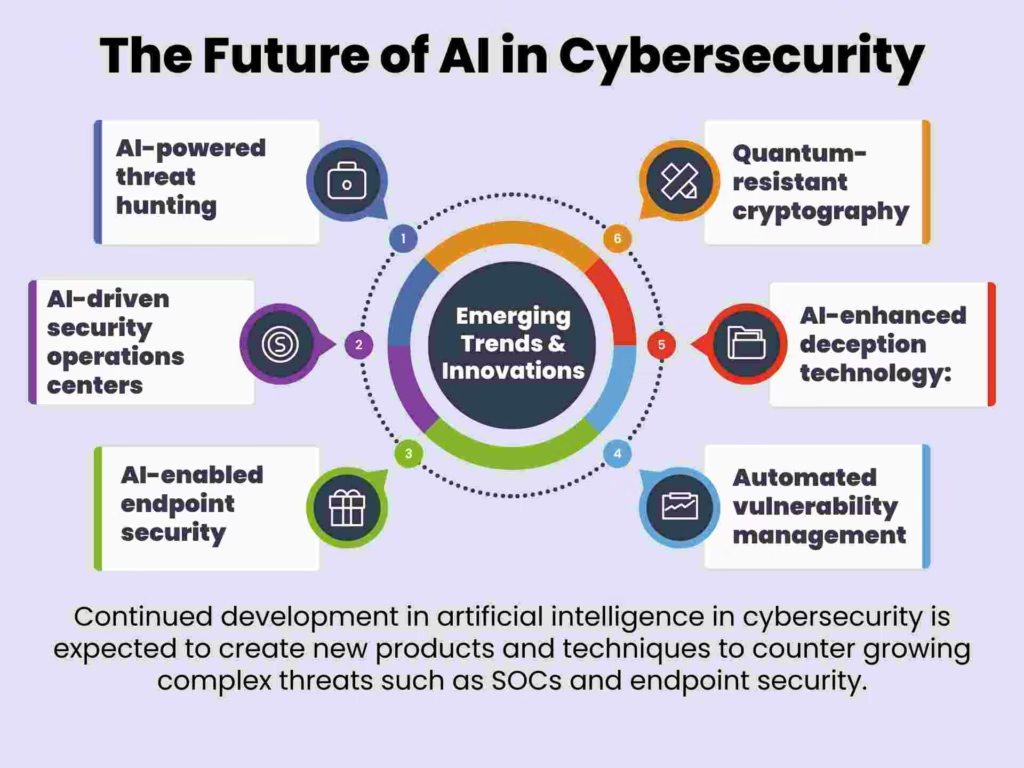
Career Opportunities in Cyber Security
The call for for cyber protection specialists is anticipated to bounce in 2026. Roles inclusive of moral hackers, protection analysts, cloud protection engineers, SOC analysts and cyber safety consultants could be fairly favourite.
Benefits of pursuing a profession in cyber protection:
- High salaries and process stability
- Global demand for skilled experts
- Opportunities for specialization in AI, cloud or IoT protection
- Continuous mastering and growth capacity
For students and experts, cyber protection gives a profitable career with long term possibilities in an ever growing field.
Future Technologies in Cyber Security
Several rising technologies will form the destiny of cyber protection:
- Quantum Encryption: Stronger encryption techniques to counter the energy of quantum computing.
- Blockchain Security: Decentralized security frameworks to save you tampering and fraud.
- Behavioral Analytics: Monitoring person conduct to hit upon anomalies and prevent insider threats.
- Autonomous Security Systems: AI pushed structures which can come across and neutralize threats with out human intervention.
As cyber threats hold to evolve, destiny technologies will play a critical function in strengthening cyber safety defenses. By 2026 and past, advanced improvements will help agencies stumble on threats quicker, protect sensitive records and respond to assaults greater effectively. Below are the important thing future technology shaping cyber security. These upgrades will redesign how organizations defend themselves in a complicated interconnected digital worldwide.
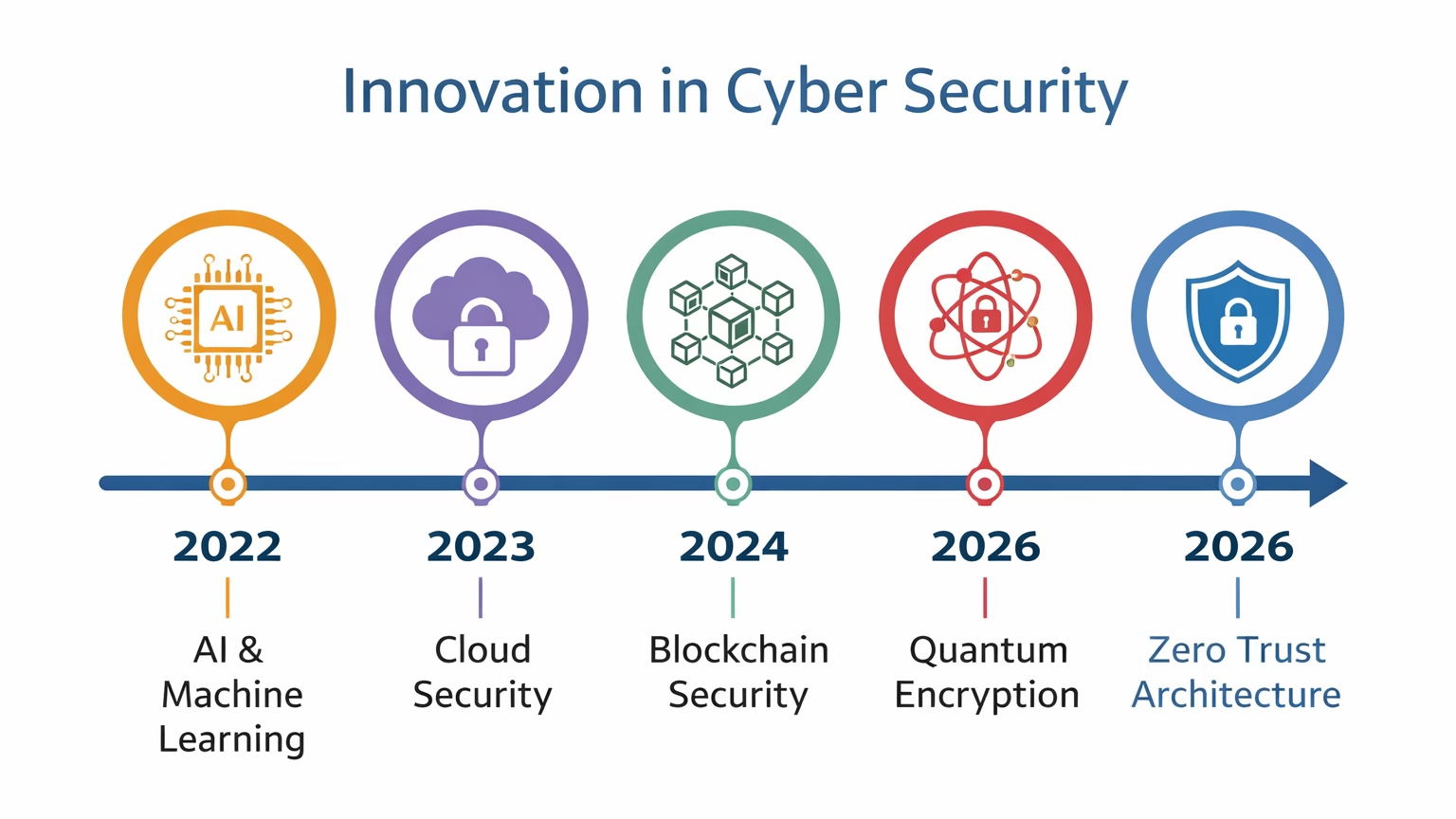
Cyber Security Innovations 2022 to 2026
2022 – Stronger Endpoint Security
In 2022 companies centered on protective laptops, mobiles and far flung paintings gadgets. Endpoint Detection and Response (EDR) gear became popular to forestall malware and phishing attacks early.
2023 – Zero Trust Security Adoption
The Zero Trust security version won momentum in 2023. Companies stopped trusting users by using default and started verifying every login, tool and community request to prevent records breaches.
2024 – AI Based Threat Detection
Artificial Intelligence started out gambling a primary role in cyber safety in 2024. AI structures helped come across unusual conduct, predict cyber attacks and respond quicker than manual tracking.
2025 – Smarter Cloud and AI Security
In 2025, cyber security innovation centered heavily on cloud safety and artificial intelligence. AI-powered tools were extensively used to come across threats in actual time, analyze person behavior and decrease reaction time. Cloud local safety platforms helped companies guard data across multi cloud environments greater efficaciously.
2026 – Automated and Predictive Cyber Defense
In 2026, cyber protection moved closer to automation and prediction. Security systems have become capable of identifying risks earlier than assaults befell. Zero Trust structure became the same old, and automated reaction systems reduced the want for manual intervention.
Conclusion
Cyber security in 2026 is becoming a business-wide responsibility. AI, ransomware, cyber-enabled fraud, cloud dependencies, supply chain vulnerabilities, identity attacks, connected devices, and geopolitical risks are creating a more complex digital threat environment.
At the same time, organizations have more powerful defensive technologies available than ever before.
AI can improve threat detection and response. Zero Trust can strengthen access control. Automation can accelerate security operations. Cloud security can protect modern infrastructure. Strong identity management can reduce unauthorized access. Cyber resilience can help organizations recover when prevention fails.
The most effective approach is not to depend on one security tool or strategy.
Businesses need a layered cybersecurity framework that combines people, processes, technology, governance, and resilience.
As digital ecosystems become more interconnected, cybersecurity will increasingly become a foundation for business continuity, customer trust, innovation, and long-term digital growth.
FAQs
What are the biggest cybersecurity trends in 2026?
Major trends include AI-powered cybersecurity, AI-related vulnerabilities, cyber-enabled fraud, ransomware, cloud security, supply-chain security, Zero Trust, identity security, AI-agent security, and cyber resilience.
What is the biggest cybersecurity threat in 2026?
There is no single threat that affects every organization equally. AI-related vulnerabilities, cyber-enabled fraud, phishing, ransomware, and supply-chain risks are among the major concerns highlighted by cybersecurity leaders.
How is AI changing cybersecurity?
AI is being used by defenders to detect threats, analyze data, identify anomalies, and accelerate response. Attackers can also use AI to scale phishing, social engineering, fraud, and other malicious activities.
Why is Zero Trust important?
Zero Trust reduces reliance on traditional network boundaries by requiring users, devices, and other entities to be continuously verified before and during access to resources.
How can businesses protect against ransomware?
Businesses should use layered security controls including MFA, endpoint protection, vulnerability management, network segmentation, employee training, protected backups, monitoring, and tested incident response procedures.
Why is supply-chain security important?
Businesses increasingly depend on third-party software, cloud providers, vendors, and platforms. A security problem within one supplier can potentially affect many organizations connected to it.
What is cyber resilience?
Cyber resilience is an organization’s ability to prepare for, withstand, respond to, recover from, and adapt to cyber incidents while maintaining critical operations.
Will AI replace cybersecurity professionals?
AI is more likely to augment cybersecurity professionals than eliminate the need for them. Security teams still need human judgment for investigation, risk assessment, governance, strategic decisions, and incident management.
What should businesses prioritize for cybersecurity in 2026?
Businesses should prioritize identity security, MFA, Zero Trust principles, vulnerability management, protected backups, cloud security, vendor risk management, AI security, employee awareness, continuous monitoring, and incident response.
What is the future of digital protection?
Digital protection is moving toward continuous verification, AI-assisted detection, automated response, stronger identity controls, AI governance, supply-chain security, and organization-wide cyber resilience.