

In the last ten years, digital marketing strategies have changed dramatically, with the advent of social media taking precedence. It seems like everywhere people go, there are advertisements through Instagram Reels, LinkedIn campaigns, and all kinds of other forms of social media marketing. However, despite this rapid growth in innovation, marketers are now faced with growing difficulties due to factors such as declining organic reach, increased costs of advertisement placement, and ever-changing algorithms.
However, within this period of constant change, email marketing has remained a steadfast tool for effective marketing and has even become smarter and more innovative. Despite its seeming antiquity relative to recent innovations, It is hardly out of place.
Instead, the question must be asked: How can this remain a better return on investment than social media?
Let’s examine this further.
Email Marketing ROI Definition
In email marketing, ROI is the ratio of profits to expenses.
Not only does it represent performance, but it also indicates the effectiveness, scalability, and profitability of your activities.
Formula:
ROI = (Revenue – Cost) / Cost × 100
The distinctive feature of email is its ability to bring you long-term income without ongoing investments, whereas social media advertising demands constant outlays.
The Importance of ROI for in the Future
- Marketing budgets are shrinking
- Companies need tangible outcomes
- Vanity marketing is giving way to performance-driven tactics
That’s why ROI-based campaigns will be a necessity rather than an option in the future
Core Advantage: Ownership vs Dependency

Another reason why it beats social media is ownership. As you build your email list, you have full ownership of the list. You can contact them at any time you want, without using third-party channels. In contrast, social media audiences are owned by algorithms of these platforms.
Email Marketing (Owned Channel)
- You control communication timing and frequency
- No algorithm interference
- Long-term asset for your business
- Stable reach and engagement
Social Media (Rented Channel)
- Visibility depends on algorithms
- Organic reach is declining
- Paid ads are often required
- Audience access can change anytime
This difference alone has a massive impact on long-term ROI.
Email vs Social Media: Detailed ROI Comparison
| Factor | Email Marketing | Social Media Marketing |
|---|---|---|
| Audience Ownership | Full control | Platform-controlled |
| Cost Structure | Low, scalable | High, increases with reach |
| Reach Consistency | Stable | Fluctuates |
| Conversion Rate | High (targeted) | Lower (broad audience) |
| Personalization | Advanced | Limited |
| Long-Term Value | High | Medium |
| ROI Potential | Very High | Unpredictable |
Why Email Marketing Continues to Outperform Social Media
Direct contact with consumers is among the most significant benefits of email marketing. The process involves sending messages directly to interested individuals. Such an approach is much better than posting on social media, which highly depends on algorithms to determine visibility.
The social media platforms regularly update their algorithms, limiting reach for some brands. As a result, many companies struggle to post organically because organic reach is falling significantly. The businesses must pay additional costs to ensure visibility, especially when their posts get buried under numerous updates.
Unlike social media marketing, It offers more flexibility for brands. This strategy allows businesses to send information to interested consumers without relying on algorithms. For example, a company may send an email newsletter to its subscribers whenever it wants, regardless of changes made by the social media platforms.
Email Marketing Builds Stronger Relationships
Social media usually aims for temporary engagement. Users tend to rapidly scroll through the feeds and interact with the posts briefly before moving on to the next ones. Although this helps create visibility, it does not necessarily establish long-lasting customer connections.
With email marketing, however, companies can foster a deeper connection with customers. Companies can use emails to share knowledge, updates about products and services, personalized recommendations, newsletters, and special offers with their clients. The use of emails marketing ensures that brands maintain contact with their customers from start to finish.
For instance, a customer who signs up for a brand’s newsletter can expect to receive:
- Welcome emails
- Educational content
- Product recommendations
- Exclusive discounts
- Invitations to events
- Loyalty rewards
Gradually, customers grow comfortable with the brand, eventually considering it a valuable entity as opposed to merely being promotional. This is another reason why emails marketing tends to be more effective than social media marketing in fostering customer loyalty.
Social Media Creates Visibility but Not Always Conversions
Social media is ideal for gaining visibility and getting noticed. Going viral on social media will help in generating quick visibility for any business. Collaborating with influencers and trending topics will also be beneficial for a brand’s visibility. But visibility doesn’t necessarily mean conversion.
Many social media users use the platform casually without the intent of buying anything. People might like a post, watch an advertisement video, or share the information found online without thinking of purchasing from the business. Social media users are more into entertainment than purchasing anything.
Email marketing is quite different from social media. Customers give their email addresses voluntarily because they are interested in receiving notifications from the company. Email marketing campaigns generally have higher conversion rates than social media campaigns.
The Power of Personalization in Email Marketing
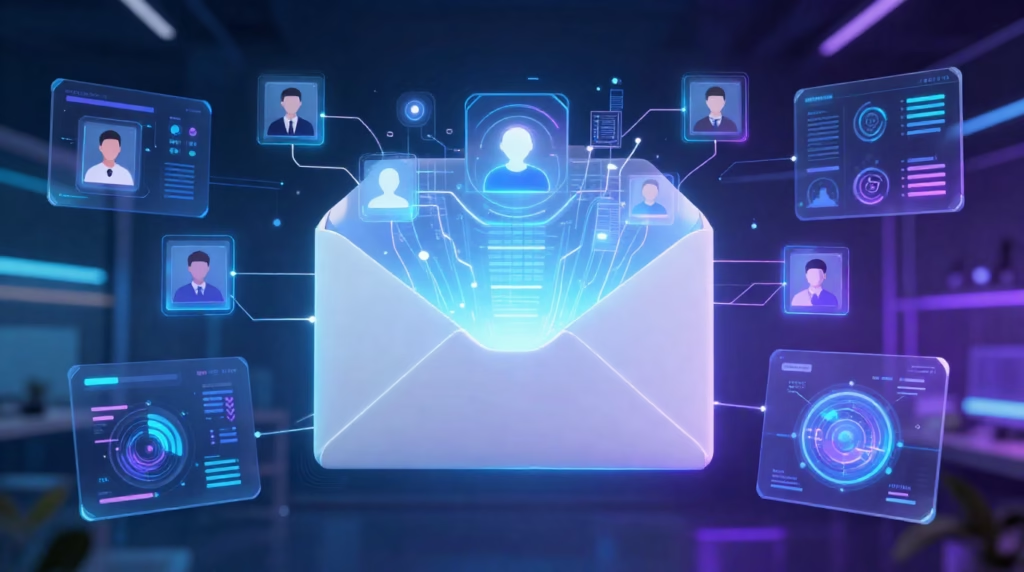
Today’s consumer is seeking personalized experience. Generic marketing messages are losing relevance because customers want brands to recognize their interests, preferences, and requirements.
The potential for personalization in email marketing is far greater than in social media. Businesses can segment their audience using various criteria such as:
- Purchase behavior
- Browsing behavior
- Industry sector
- Demographics
- Customer interest
- Customer engagement
It is possible to deliver highly tailored messages to different customer segments through email marketing.
For instance, an e-commerce retailer may suggest items based on past purchase data, and a SaaS provider may offer educational content based on users’ actions. Customers find personalized emails engaging and informative, thereby improving engagement and conversion rates.
With the continuous development of Artificial Intelligence technology, personalization in email marketing is expected to reach new heights in the future. AI-driven algorithms analyze customers’ behavior in real-time and customize messaging accordingly.
The Role of AI in the Future of Email Marketing
Artificial Intelligence is changing email marketing altogether. With artificial intelligence, organizations can automate processes, gain insights into customer actions, and enhance campaign results more effectively than ever before.
Predictive analysis is one of the significant benefits of using AI in email marketing. AI systems can predict which customers will buy products, unsubscribing from newsletters, or engage with email campaigns. Thus, businesses can use predictive analytics to make their email marketing efforts more effective and accurate.
Additionally, AI technologies enable organizations to find the best times for sending emails to individual users and recommend suitable subject lines or contents. Thus, AI can help in maximizing the efficiency of each marketing campaign.
Looking ahead into the future, AI will play an increasingly important role in email marketing. In particular, businesses will start implementing customer journeys that change in response to customer behavior in real-time. Email marketing has a unique advantage over social media marketing due to this capability.
Automation Is Driving Future Email Marketing Success
Email Marketing Automation is another factor contributing to its ROI success in digital marketing. Email marketing automation ensures consistent customer engagement through automatic email sequences without having to manually send each individual email.
Examples of email marketing automation include:
- Onboarding new subscribers
- Abandonment email campaigns
- Lead nurturing emails
- Re-engagement campaigns
- Post-purchase follow-up emails
- Customer loyalty programs
Such automated emails run consistently behind the scenes and help generate leads and sales even when companies are not actively running campaigns.
Social media marketing usually requires constant effort for content creation and interaction to stay active. In contrast, email marketing automation ensures effective scalability and customization.
Email Marketing Supports Long-Term Business Growth
However, sustainability stands out to be among the main factors that separate email marketing from social media campaigns. The trends in social media keep changing every now and then. Different platforms emerge or go extinct with time. Any company that relies on just one platform faces very high risks of losing its audience if the algorithms used by this platform change at any point in time.
In email marketing, however, there is much more stability in the sense that any company has full control of the subscribers’ information, thus having an asset which will continue making money for the firm indefinitely.
Cost Efficiency of Email Marketing
Email marketing also proves to be much cheaper than many social media marketing campaigns. Conducting effective campaigns through social media often involves expenses on advertising, influencer marketing, video production, graphic designing, and consistent content creation.
The process of email marketing generally involves less expense but provides higher ROI. Email marketing proves to be ideal for small business owners who do not have large amounts of money for marketing.
With a limited number of subscribers, a lot of profit can be earned.
The Future of Social Media Marketing
Social media marketing will still be an essential part of digital marketing as the power of social media such as Instagram, TikTok, LinkedIn, and YouTube for building awareness cannot be ignored.
Nevertheless, social media marketing becomes more challenging. There are increasing numbers of businesses allocating budget and resources for content and paid advertisements in order to enhance competitiveness on social media platforms. Organic reach is continually decreasing, making it difficult to gain exposure from organic engagement.
At the same time, there is too much content to consume, leaving consumers no time for thorough reading and consideration.
As a result, social media becomes more effective in audience attraction whereas emails prove to be more powerful in relationship-building and conversion rate generation.
Why Businesses Should Combine Email and Social Media
The most effective marketing techniques are those that utilize the benefits of both mediums. Social media allows you to reach out to new people and get visible, whereas email marketing allows you to turn those people into buyers.
These businesses will be able to nurture these leads via email marketing after signing up for their newsletters.
| Social Media Activities | Purpose | Email Marketing Follow-Up | Final Business Benefit |
|---|---|---|---|
| Offering free resources | Attract new audiences | Send personalized nurturing emails | Convert leads into customers |
| Encouraging newsletter subscriptions | Build email lists | Share regular updates and offers | Increase customer engagement |
| Providing educational content | Build trust and authority | Deliver targeted email campaigns | Improve lead nurturing |
| Generating community interaction | Increase brand awareness | Continue conversations through email | Strengthen customer relationships |
| Running social media campaigns | Drive traffic and visibility | Send follow-up promotional emails | Boost conversions and sales |
The Rise of Humanized Marketing
Humanized Communication in a World Dominated by AI Content
With the proliferation of AI content creation, there is an increasing need for humanized communication.
For future success in email marketing, companies will need to focus on:
- Conversational tone
- Storytelling
- Informative content
- Transparency
- Personal experience
The ability of businesses to connect with customers in a conversational tone will be far more effective than automated communication devoid of any personal touch.
A humanized approach to communication instills a sense of trust, which continues to be the key aspect of customer loyalty and buying behavior.
Privacy and First-Party Data Will Increase Email Marketing Value
The Rise in Privacy and First Party Data Will Make Email Marketing More Valuable
Privacy laws will play a huge role in changing digital marketing. The era of third party cookies is ending, and consumers are getting more concerned about their data being used.
One major benefit of email marketing is that it uses mostly first party data. The users themselves willingly share their details when they sign up for emails or newsletters.
Email marketing will be very helpful to companies that wish to use data ethically in the coming years.
Challenges Email Marketing Must Overcome
Despite the fact that email marketing continues to be one of the most powerful tools in business, companies still encounter some obstacles.
First, it is rather challenging to overcome inbox cluttering. People have to open multiple emails each day, and companies should come up with something unique and useful.
Second, deliverability plays an essential role here. Companies should be careful about their marketing practices and keep a high-quality list of subscribers.
Third, it is better to send fewer valuable messages instead of numerous promotional emails.
Conclusion
Email marketing will keep beating social media marketing in terms of effectiveness as it involves relationship building, personalization, ownership, and customer lifetime value. While social media marketing ensures visibility and interaction, email marketing ensures deeper relationships and better conversions.
The prospects of email marketing look brighter with each passing day thanks to continuous developments in artificial intelligence, automation, and personalization. Those companies which manage to build high-quality email lists will benefit from these marketing assets for a long time.
Social media will continue being helpful for audience attraction and brand recognition; however, email marketing will remain superior in terms of ROI, customer retention, and company success.
In this constantly evolving world where all things depend on changing algorithms and increased competition, the value of direct communication and an owned audience is greater than ever before. This is the main reason why email marketing remains superior to social media marketing and will probably stay that way for a long time.
Frequently Asked Questions (FAQs)
Email marketing continues to deliver higher ROI because it allows businesses to communicate directly with customers who have already shown interest in their products or services. Unlike social media, where algorithms control visibility, email campaigns reach subscribers more consistently. Email also supports better personalization, automation, and lead nurturing, which improves conversions and long-term customer retention.
2. Is email marketing still effective in the future?
Yes, email marketing is expected to remain highly effective in the future. Advancements in Artificial Intelligence, automation, and customer personalization are making email campaigns smarter and more targeted. Businesses are increasingly focusing on owned audiences and first-party data, which makes email marketing even more valuable in a privacy-focused digital environment.
3. What is the average ROI of email marketing?
Email marketing is known for generating one of the highest returns among digital marketing channels. Many industry reports estimate that businesses can earn around $36 to $42 for every $1 spent on email marketing campaigns. However, ROI depends on factors such as audience quality, content strategy, personalization, and campaign optimization.
Social media is excellent for brand awareness and audience engagement, but it has limitations. Businesses do not fully control their followers because social media platforms depend on algorithms. Organic reach can decline at any time, and competition for visibility is increasing. Email marketing helps businesses maintain direct communication with customers without depending entirely on social media platforms.
5. How does email marketing improve customer relationships?
Email marketing helps businesses maintain long-term communication with customers through personalized and valuable content. Brands can send welcome emails, educational newsletters, product recommendations, exclusive offers, and follow-up messages. These interactions build trust, loyalty, and stronger customer relationships over time.
6. What role does AI play in the future of email marketing?
Artificial Intelligence is transforming email marketing by improving personalization, automation, customer segmentation, and predictive analytics. AI can help businesses optimize subject lines, determine the best sending times, analyze customer behavior, and create more relevant content. This leads to higher open rates, better engagement, and improved conversions.
Both channels serve different purposes. Social media advertising is effective for increasing visibility and attracting new audiences, while email marketing is stronger for lead nurturing, customer retention, and sales conversions. Many successful businesses combine both strategies to maximize marketing performance.
8. How can businesses improve email marketing ROI?
Businesses can improve email marketing ROI by focusing on high-quality subscriber lists, audience segmentation, personalized content, mobile optimization, and automation. Sending relevant and valuable emails consistently helps increase engagement and customer loyalty.