Search engine optimization has entered a new era. For years, businesses focused on ranking web pages in traditional search engines by targeting keywords, earning backlinks, improving page speed, and creating valuable content. While these practices continue to matter, the rapid rise of artificial intelligence has fundamentally changed how people discover information online. Today, millions of users ask questions directly to AI-powered assistants such as ChatGPT, Google AI Search, Gemini, Claude, and Perplexity instead of clicking through pages of search results. This shift has given rise to a new optimization strategy known as LLM SEO.
LLM SEO refers to the process of optimizing websites and digital content so that Large Language Models (LLMs) can easily understand, trust, and reference them when generating AI-powered answers. Unlike traditional SEO, where success is measured by keyword rankings and website traffic, LLM SEO focuses on increasing your brand’s visibility within AI-generated responses. If your content is frequently cited, summarized, or recommended by AI assistants, your business gains credibility, attracts qualified visitors, and stays competitive in the evolving search landscape.
The growing popularity of generative AI has changed user behavior dramatically. Instead of searching for “best CRM software” and opening multiple websites, users now ask AI assistants questions like, “What is the best CRM for small businesses?” or “Compare the top CRM platforms for startups.” AI models analyze trusted sources, combine information from multiple websites, and present concise answers. This means your content must do more than rank it must become a trusted source that AI systems consider reliable enough to reference.
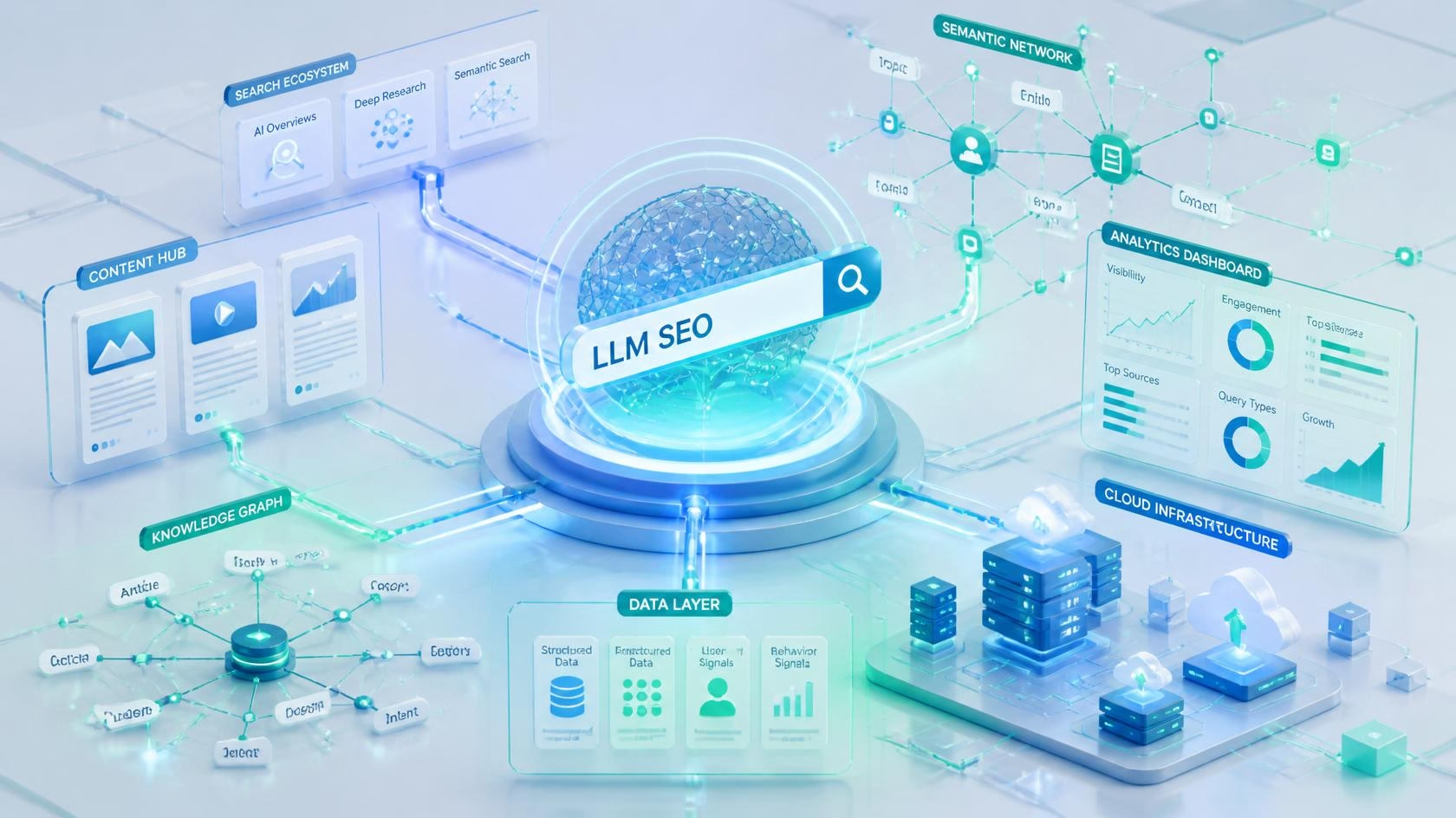
What Is LLM SEO?
LLM SEO is the practice of optimizing websites, web pages, and digital content so that Large Language Models (LLMs) can effectively discover, understand, interpret, and reference the information when generating responses for users. Rather than focusing only on traditional search engine rankings, LLM SEO aims to improve your website’s visibility across AI-powered search experiences, conversational assistants, and generative search platforms.
Large Language Models are advanced artificial intelligence systems trained on enormous datasets that include books, articles, websites, research papers, documentation, and other publicly available information. These models understand language by identifying relationships between words, concepts, and entities rather than relying solely on exact keyword matches. Because of this, modern AI search rewards comprehensive, context-rich, and semantically relevant content instead of pages that simply repeat target keywords.
The primary objective of LLM SEO is to help AI systems recognize your website as a reliable source of information. When AI assistants generate answers to user questions, they prioritize content that demonstrates expertise, authority, trustworthiness, and topical depth. Websites that consistently publish accurate, well-structured, and informative content are far more likely to be referenced than websites created primarily for search engine rankings.
Unlike traditional SEO, where the ultimate goal is earning a position on the first page of search results, LLM SEO focuses on becoming part of the AI-generated answer itself. This shift requires businesses to rethink their content strategy. Instead of producing multiple articles targeting slight keyword variations, companies should build comprehensive topic clusters that answer every major question users may ask about a subject.
How ChatGPT, Gemini, Claude, and AI Search Engines Choose Content
One of the biggest questions businesses have about LLM SEO is how AI platforms decide which websites to reference when generating answers. Unlike traditional search engines that mainly rank web pages based on hundreds of ranking signals, Large Language Models evaluate content based on relevance, context, authority, and usefulness. Their goal is to provide users with accurate, complete, and trustworthy answers instead of simply listing links.
When a user asks a question such as “What is the best LLM SEO strategy?” an AI assistant first understands the intent behind the query. It then identifies the key concepts, determines the information required, and generates an answer using trusted knowledge and, in many cases, current web content. This means your website needs to provide valuable information that is easy for AI systems to understand and reference.
AI search platforms typically favor websites that:
- Publish original, high-quality content
- Demonstrate expertise in a specific industry
- Cover topics comprehensively
- Use clear headings and logical content structure
- Maintain factual accuracy
- Update content regularly
- Build topical authority through multiple related articles
- Have strong website credibility
- Include structured data where appropriate
- Provide a good user experience
Businesses that consistently meet these standards improve their chances of being referenced across multiple AI-powered platforms rather than relying solely on traditional search rankings.
Factors AI Search Systems Evaluate
| Ranking Factor | Why It Matters for LLM SEO |
|---|---|
| Content Accuracy | AI prefers factually correct information. |
| Topical Authority | Multiple high-quality articles improve trust. |
| Semantic Relevance | AI understands related concepts and entities. |
| EEAT Signals | Demonstrates experience, expertise, authority, and trust. |
| Structured Content | Makes information easier to interpret. |
| Fresh Content | Updated articles remain more relevant. |
| Brand Reputation | Recognized brands receive greater trust. |
| Internal Linking | Helps AI understand relationships between topics. |
Unlike keyword stuffing strategies from the past, modern AI rewards depth, clarity, and genuine expertise.

Core Ranking Signals That Matter in LLM SEO
Although AI search platforms use different technologies, many of their evaluation signals overlap. Websites that perform well in LLM SEO usually focus on building long-term authority rather than chasing short-term ranking tactics.
The following ranking signals are becoming increasingly important:
1. Topical Authority
Instead of publishing isolated blog posts, create an entire knowledge hub around your niche. If your website focuses on AI marketing, publish comprehensive articles covering:
- LLM SEO
- AI SEO
- Generative Engine Optimization
- Prompt Engineering
- AI Search Optimization
- Semantic SEO
- AI Content Marketing
- Entity SEO
This interconnected content helps AI recognize your website as an authority on the subject.
2. Content Depth
AI models prefer detailed resources that answer every major question users might have. Comprehensive guides often outperform shorter articles because they provide greater context and reduce the need for additional searches.
High-quality articles should include:
- Definitions
- Step-by-step explanations
- Examples
- Comparison tables
- Best practices
- Common mistakes
- FAQs
- Actionable recommendations
3. Semantic Optimization
Modern LLM SEO focuses on concepts instead of repeating the same keyword.
For example, an article about LLM SEO should naturally include related terms such as:
- AI Search
- Large Language Models
- ChatGPT
- Google AI Search
- Gemini
- Claude
- Perplexity
- Schema Markup
- Semantic Search
- Entity SEO
- AI Content Optimization
- Natural Language Processing
Using related terminology helps AI understand the complete context of your article.
4. Website Trust
Trust plays a major role in AI visibility.
Ways to increase trust include:
- Publishing original research
- Citing credible sources
- Displaying author information
- Updating outdated content
- Maintaining accurate facts
- Securing your website with HTTPS
- Providing transparent business information
The more trustworthy your website appears, the more likely AI systems are to reference it.
Building Topical Authority for LLM SEO
Topical authority is one of the strongest competitive advantages in LLM SEO. Rather than producing random articles across unrelated subjects, successful websites focus on becoming experts within one specific niche.
For example, instead of writing only one article about LLM SEO, create an interconnected content cluster.
| Pillar Topic | Supporting Articles |
|---|---|
| LLM SEO | What Is LLM SEO? |
| LLM SEO | LLM SEO Best Practices |
| LLM SEO | AI Search Ranking Factors |
| LLM SEO | ChatGPT SEO Guide |
| LLM SEO | Entity SEO Explained |
| LLM SEO | Semantic SEO Strategies |
| LLM SEO | AI Search Optimization Tools |
| LLM SEO | Future of AI Search |
This structure sends a strong signal that your website has deep expertise in the topic.
Benefits of Building Topic Clusters
- Improves AI understanding of your niche
- Strengthens internal linking
- Increases user engagement
- Builds long-term authority
- Encourages AI citations
- Improves traditional SEO rankings
- Supports higher organic traffic
- Creates a better user experience
Publishing multiple high-quality articles around one topic is significantly more effective than publishing isolated posts across unrelated industries.

Why Entity SEO Is Becoming Essential
One of the biggest changes introduced by AI search is the growing importance of entities.
An entity is a uniquely identifiable object that AI systems understand independently of keywords. Entities may include:
- Companies
- Products
- Technologies
- People
- Locations
- Organizations
- Programming languages
- Industry concepts
For example, when discussing LLM SEO, AI may automatically recognize related entities such as:
- ChatGPT
- Google AI Search
- Gemini
- Claude
- Microsoft Copilot
- Perplexity
- OpenAI
- Anthropic
- Large Language Models
The stronger your website’s association with relevant entities, the easier it becomes for AI systems to understand your expertise.
Ways to Strengthen Entity Signals
- Maintain consistent brand information across platforms.
- Use structured schema markup.
- Publish detailed author profiles.
- Build citations from reputable websites.
- Earn mentions from industry publications.
- Cover related topics consistently.
- Create comprehensive educational resources.
- Use natural language instead of keyword stuffing.
As AI search continues to evolve, entity optimization will become just as important as traditional keyword optimization. Businesses that invest in building strong entity relationships today will be better positioned to gain visibility across ChatGPT, Gemini, Claude, Perplexity, Google AI Search, and future AI-powered search platforms.
EEAT: The Foundation of Successful LLM SEO
One of the most important concepts in LLM SEO is EEAT, which stands for Experience, Expertise, Authoritativeness, and Trustworthiness. Although this framework has long been associated with traditional SEO, it has become even more critical in the age of AI search. Large Language Models aim to provide users with reliable and accurate information, making EEAT a key factor in determining which sources are most likely to be referenced.
When AI platforms analyze content, they do not simply count keywords or backlinks. They evaluate whether the information appears credible, comprehensive, and supported by expertise. Websites that consistently demonstrate EEAT are more likely to become trusted sources for AI-generated answers.
Components of EEAT
| EEAT Element | How It Helps LLM SEO |
|---|---|
| Experience | Shows practical knowledge through real-world examples. |
| Expertise | Demonstrates deep understanding of the subject. |
| Authoritativeness | Builds recognition as an industry leader. |
| Trustworthiness | Ensures factual, transparent, and reliable information. |
Ways to Improve EEAT
- Publish content written or reviewed by industry experts.
- Include detailed author biographies.
- Add references to credible sources when appropriate.
- Share original research, surveys, or case studies.
- Update articles regularly with the latest information.
- Display company contact information and privacy policies.
- Ensure your website uses HTTPS and follows security best practices.
- Maintain consistent branding across all digital channels.
A website with strong EEAT signals is more likely to be trusted by both users and AI systems.
Schema Markup and Structured Data for LLM SEO
Schema markup is a form of structured data that helps search engines and AI systems understand the content on your website more effectively. While users cannot see schema directly, it provides valuable context that enables AI to identify entities, relationships, and important page details.
Adding structured data improves the clarity of your content and increases the likelihood of appearing in rich search features and AI-generated responses.
Common Schema Types for LLM SEO
| Schema Type | Purpose |
|---|---|
| Article | Describes blog posts and news articles. |
| FAQ | Organizes frequently asked questions. |
| Organization | Defines business information. |
| Person | Identifies authors and contributors. |
| Product | Describes products and services. |
| Breadcrumb | Improves website navigation. |
| HowTo | Structures instructional content. |
| Review | Highlights ratings and reviews. |
Benefits of Schema Markup
- Helps AI understand page context.
- Improves search engine indexing.
- Strengthens entity recognition.
- Increases eligibility for rich results.
- Supports knowledge graph connections.
- Makes content easier to interpret.
- Enhances user experience.
For LLM SEO, schema markup should complement high-quality content rather than replace it. Structured data works best when paired with comprehensive, well-written articles.
Creating AI-Friendly Content
Content remains the heart of every successful LLM SEO strategy. However, writing for AI search does not mean writing for machines. Instead, it means creating content that is easy for both humans and AI systems to understand.
The best AI-friendly content answers questions clearly, explains concepts thoroughly, and follows a logical structure.
Characteristics of AI-Friendly Content
- Uses descriptive headings and subheadings.
- Answers the primary question early in the article.
- Explains complex concepts in simple language.
- Covers related subtopics naturally.
- Includes practical examples.
- Uses comparison tables where helpful.
- Avoids unnecessary repetition.
- Provides actionable insights.
- Maintains factual accuracy.
- Updates information regularly.
Instead of writing separate short articles for every keyword variation, create comprehensive resources that address multiple related questions within one topic. This approach improves user satisfaction and increases the chances of AI referencing your content.
Example of Content Structure
| Section | Purpose |
|---|---|
| Introduction | Explain the topic and user intent. |
| Definition | Provide a clear explanation. |
| Benefits | Describe advantages. |
| Process | Explain how it works. |
| Best Practices | Offer actionable advice. |
| Common Mistakes | Help users avoid errors. |
| FAQs | Answer related questions. |
| Conclusion | Summarize key takeaways. |
A well-organized article helps AI identify important information quickly and accurately.
Internal Linking Strategies for LLM SEO
Internal linking is often overlooked, but it plays a significant role in helping AI understand your website’s structure. Every internal link provides context about how different pages relate to each other.
When your content is connected logically, AI can better recognize your expertise within a topic.
Benefits of Internal Linking
- Improves topical authority.
- Helps AI understand content relationships.
- Encourages visitors to explore more pages.
- Reduces bounce rate.
- Improves crawl efficiency.
- Distributes page authority across the website.
- Supports better indexing.
For example, if you publish an article about LLM SEO, you should internally link to related articles such as:
- AI Search Optimization
- Semantic SEO
- ChatGPT SEO
- Entity SEO
- Technical SEO
- Schema Markup
- Content Marketing
- Prompt Engineering
This creates a connected knowledge hub that demonstrates expertise.

Optimizing Content for Featured AI Answers
One of the primary goals of LLM SEO is to increase the likelihood that AI systems reference your content directly when generating answers.
To achieve this, structure your content in a way that makes important information easy to extract.
Best Practices
- Start sections with concise definitions.
- Answer questions directly before expanding.
- Use numbered steps for processes.
- Include comparison tables.
- Break long paragraphs into manageable sections.
- Add FAQs that address common user queries.
- Define technical terms clearly.
- Support statements with relevant examples.
- Use descriptive headings.
Example
Instead of writing:
“Many businesses are beginning to adopt LLM SEO because artificial intelligence is changing search behavior.”
Write:
LLM SEO is the process of optimizing website content so that AI systems such as ChatGPT, Gemini, Claude, and Google AI Search can understand, trust, and reference it when generating answers.
This direct format is easier for AI systems to interpret and quote accurately.
Common LLM SEO Mistakes to Avoid
As businesses begin implementing LLM SEO, several common mistakes can reduce their chances of appearing in AI-generated responses.
Frequent Mistakes
- Publishing thin content with little value.
- Focusing only on keyword density.
- Ignoring semantic relevance.
- Covering too many unrelated topics.
- Neglecting internal linking.
- Publishing outdated information.
- Using AI-generated content without human editing.
- Ignoring structured data.
- Creating duplicate content.
- Forgetting mobile optimization.
- Failing to update older articles.
- Overlooking page speed and technical SEO.
Mistake vs Better Approach
| Common Mistake | Better LLM SEO Practice |
|---|---|
| Keyword stuffing | Natural semantic writing |
| Thin articles | Comprehensive guides |
| Few internal links | Strong topic clusters |
| Generic content | Original insights and research |
| Outdated information | Regular content updates |
| Poor structure | Clear headings and tables |
| No schema | Implement structured data |
| Weak authority | Build EEAT and topical expertise |
Avoiding these mistakes helps establish your website as a trustworthy resource that AI platforms are more likely to recommend.
By combining high-quality content, strong EEAT signals, structured data, logical internal linking, and user-focused writing, businesses can significantly improve their visibility in AI-powered search experiences and strengthen their overall LLM SEO strategy.
Best Tools for LLM SEO
As AI-powered search continues to evolve, businesses need the right tools to monitor performance, identify optimization opportunities, and improve visibility across AI search platforms. While no single platform measures every AI citation today, combining SEO, analytics, and AI monitoring tools provides valuable insights into how your content performs.
The following tools can support a successful LLM SEO strategy.
| Tool | Primary Use | Why It Matters for LLM SEO |
|---|---|---|
| Google Search Console | Monitor search performance | Identify pages gaining impressions and clicks |
| Google Analytics 4 | Analyze user behavior | Measure engagement and conversions |
| Ahrefs | Keyword and backlink research | Discover content opportunities and authority gaps |
| Semrush | SEO audits and competitor analysis | Optimize technical and on-page SEO |
| Screaming Frog | Website crawling | Detect indexing and technical issues |
| Google Rich Results Test | Schema validation | Ensure structured data is implemented correctly |
| PageSpeed Insights | Website performance | Improve loading speed and user experience |
| Bing Webmaster Tools | Search visibility | Monitor indexing across Microsoft search |
| ChatGPT | Content ideation | Generate outlines and improve readability |
| Perplexity AI | Research | Understand how AI summarizes topics |
How to Choose the Right Tools
Before investing in multiple platforms, identify your primary objective.
- Improve technical SEO.
- Build topical authority.
- Monitor keyword rankings.
- Increase AI visibility.
- Optimize structured data.
- Track user engagement.
- Improve page performance.
- Audit website health regularly.
Using these tools together allows businesses to optimize both traditional SEO and LLM SEO, creating a stronger foundation for future AI search experiences.
Measuring the Success of Your LLM SEO Strategy
Unlike traditional SEO, where rankings are the primary performance metric, LLM SEO requires a broader approach. Businesses should evaluate both search performance and AI visibility to understand whether their optimization efforts are successful.
Several indicators can help measure progress over time.
Important Performance Metrics
| Metric | Why It Matters |
|---|---|
| Organic Traffic | Shows overall search visibility. |
| AI Mentions | Indicates brand visibility in AI-generated responses. |
| Brand Searches | Reflects increasing brand awareness. |
| Click-Through Rate | Measures search result effectiveness. |
| Time on Page | Demonstrates user engagement. |
| Returning Visitors | Indicates content value and trust. |
| Backlink Growth | Builds long-term authority. |
| Indexed Pages | Confirms proper search engine indexing. |
Additional KPIs
- Growth in branded searches.
- Increase in referring domains.
- Improved topical authority.
- Higher engagement on educational content.
- Better Core Web Vitals.
- Growth in newsletter subscriptions.
- More qualified leads.
- Higher conversion rates.
- Increased content sharing.
Regularly reviewing these metrics helps businesses identify which topics perform best and where additional optimization is needed.
Future Trends in LLM SEO
Artificial intelligence is changing search much faster than previous technological shifts. Businesses that adapt early will have a significant advantage as AI-powered discovery becomes more common.
Several emerging trends are expected to shape the future of LLM SEO.
1. AI Search Will Become Mainstream
More users are beginning their research directly within AI assistants rather than traditional search engines. This trend is expected to continue as conversational search becomes more accurate and accessible.
2. Topical Authority Will Outperform Individual Keywords
Rather than ranking isolated pages, AI systems increasingly evaluate the overall expertise of a website. Businesses with extensive knowledge hubs will gain stronger visibility.
3. Original Research Will Become More Valuable
AI platforms prioritize unique insights over duplicated information.
Content that includes:
- Industry surveys
- Original statistics
- Customer case studies
- Expert interviews
- Market research
- Proprietary frameworks
will become increasingly valuable.
4. Entity Optimization Will Continue Growing
Search engines and AI models are moving toward understanding brands as entities instead of collections of keywords.
Businesses should focus on:
- Building brand recognition.
- Maintaining consistent information.
- Strengthening author credibility.
- Expanding digital presence.
- Creating authoritative content clusters.
5. Content Quality Will Matter More Than Quantity
Publishing hundreds of average articles will become less effective than producing fewer, comprehensive, high-quality resources.
Successful content should be:
- Accurate
- Helpful
- Well-structured
- Updated regularly
- Easy to understand
- Backed by expertise
Future Outlook
| Trend | Expected Impact |
|---|---|
| Conversational Search | Higher adoption of AI assistants |
| Entity SEO | Stronger brand recognition |
| Semantic Search | Reduced importance of exact keywords |
| AI Citations | Greater emphasis on trusted sources |
| Content Depth | Better visibility for comprehensive guides |
| Structured Data | Increased AI understanding |
| User Experience | More influence on search visibility |
Businesses that invest in these trends today will be better prepared for the next generation of digital search.
LLM SEO Best Practices Checklist
The following checklist summarizes the most important actions for building a successful LLM SEO strategy.
| Checklist Item | Status |
|---|---|
| Publish comprehensive content | ✔ |
| Build topical authority | ✔ |
| Optimize semantic relevance | ✔ |
| Strengthen EEAT signals | ✔ |
| Use structured schema markup | ✔ |
| Improve Core Web Vitals | ✔ |
| Create strong internal linking | ✔ |
| Update outdated content | ✔ |
| Answer user intent clearly | ✔ |
| Build high-quality backlinks | ✔ |
| Optimize for entities | ✔ |
| Monitor search performance | ✔ |
Quick Best Practices
- Write for people first and AI second.
- Focus on solving user problems completely.
- Keep content updated with current information.
- Build clusters around your core topics.
- Use descriptive headings and logical formatting.
- Include tables, examples, and FAQs.
- Strengthen your brand’s authority online.
- Maintain a fast, secure, and mobile-friendly website.
- Produce original insights whenever possible.
- Measure results and continuously improve your strategy.
Conclusion
The future of search is no longer limited to ranking web pages. As conversational AI becomes a primary way people discover information, businesses must evolve beyond traditional optimization techniques and embrace LLM SEO. Instead of focusing only on keywords and backlinks, organizations need to build authority, create comprehensive content, strengthen entity recognition, and provide trustworthy information that AI systems can confidently reference.
A successful LLM SEO strategy combines technical excellence with high-quality content, semantic optimization, structured data, topical authority, and exceptional user experience. Websites that consistently demonstrate expertise while answering real user questions are far more likely to appear in AI-generated responses across platforms such as ChatGPT, Gemini, Claude, Perplexity, and Google AI Search.
Although AI search will continue to evolve, one principle will remain constant: the most valuable content wins. Businesses that prioritize accuracy, originality, depth, and user satisfaction will not only improve their visibility in AI-powered search but also strengthen their overall digital presence. By implementing the strategies outlined in this guide, you can future proof your website, increase brand authority, attract highly qualified visitors, and position your business for long-term success in the rapidly expanding world of LLM SEO.
Frequently Asked Questions
1. What is LLM SEO?
LLM SEO is the practice of optimizing website content so that Large Language Models like ChatGPT, Gemini, Claude, and Google AI Search can understand, trust, and reference it in AI-generated responses.
2. How is LLM SEO different from traditional SEO?
Traditional SEO focuses on improving rankings in search engine results pages, while LLM SEO aims to increase visibility within AI-generated answers by emphasizing semantic relevance, topical authority, and trustworthiness.
3. Why is LLM SEO important?
As more users rely on AI assistants for information, optimizing for LLM SEO helps businesses increase brand visibility, establish authority, and reach audiences through AI-powered search experiences.
4. Does traditional SEO still matter?
Yes. Technical SEO, quality backlinks, and keyword optimization remain important, but they should be combined with LLM SEO strategies to maximize visibility across both traditional and AI-driven search.
5. What are the most important ranking factors for LLM SEO?
Key factors include comprehensive content, EEAT, topical authority, semantic relevance, structured data, internal linking, page experience, and factual accuracy.
6. Can small businesses benefit from LLM SEO?
Absolutely. By publishing expert content, optimizing for user intent, and building authority within a niche, small businesses can improve their chances of being referenced by AI search platforms alongside larger competitors.