

A enterprise refers to any pastime or business enterprise engaged in producing, buying or promoting items and services to generate income and deliver price to clients.
In today’s virtual financial system, enterprise is going beyond conventional shops and places of work. It includes ecommerce shops, SaaS startups, freelancing platforms and digital provider vendors.
Business performs a vital role in economic boom, process introduction and innovation.
Importance of Business
Business continues to adapt hastily due to generation, globalization, and digital transformation.
Key reasons commercial enterprise is critical:
- Drives monetary boom
- Creates employment opportunities
- Encourages innovation
- Improves residing requirements
- Enables global connectivity
With online systems and digital bills, starting a commercial enterprise is now extra accessible than ever. Business is crucial because it drives financial boom, creates jobs and gives goods and offerings that enhance people’s each day lives. It encourages innovation, supports communities and generates income for individuals and governments thru taxes. A strong business surroundings also boosts development, enhances dwelling requirements and opens possibilities for entrepreneurship and worldwide change.
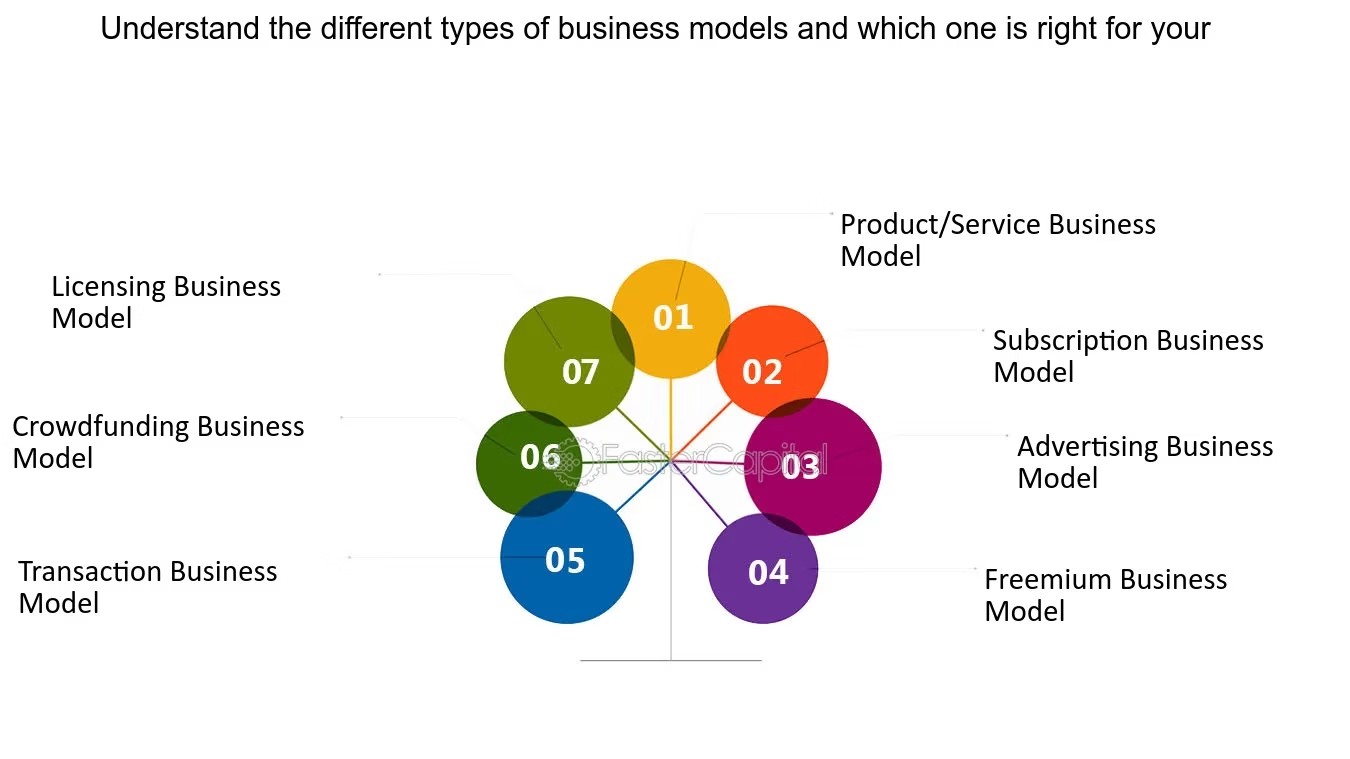
Types of Business Models
Understanding commercial enterprise models enables entrepreneurs pick the right direction.
Product-Based Business
Selling bodily or digital products.
Service-Based Business
Offering know-how or capabilities along with advertising, consulting, or development.
Ecommerce Business
Online stores selling merchandise globally.
Subscription Business
Recurring sales through memberships or SaaS.
Marketplace Business
Connecting shoppers and dealers on a platform.
Each commercial enterprise version has specific advantages and growth potential.
How to Start a Business Step-by way of-Step
Identify Business Idea
Choose a problem-solving concept with marketplace call for.
Conduct Market Research
Understand competitors, audience desires, and traits.
Create Business Plan
Define goals, sales version and marketing method.
Register Your Business
Complete felony registration and compliance.
Build Online Presence
Create a website, social media profiles, and logo identification.
Launch and Promote
Use virtual marketing to draw clients.
Business Planning Essential
A marketing strategy act as a roadmap for boom.
Key components:
- Executive precis
- Market analysis
- Business version
- Marketing plan
- Financial projections
- Growth approach
Strong planning reduce risk and improves choice making.
Business Planning Essentials Overview :
| Component | Description | Purpose | Example | Outcome |
|---|---|---|---|---|
| Executive Summary | Brief overview of the business idea | Provides quick understanding | Startup overview | Investor interest |
| Market Analysis | Research on industry and competitors | Identifies opportunities | Competitor study | Better positioning |
| Business Model | How the business earns revenue | Defines monetization strategy | Subscription model | Stable income |
| Marketing Plan | Strategies to attract customers | Builds brand awareness | Social media campaigns | Lead generation |
| Financial Plan | Budget, costs, and revenue forecast | Ensures financial stability | Sales projections | Profitability & growth |
Business planning is a crucial step that facilitates marketers set clear dreams, allocate sources correctly, and decrease dangers. A nicely structured business plan acts as a roadmap, guiding selection making and making sure lengthy term increase. Below is a easy desk highlighting key business making plans essentials.
15 Powerful Business Strategies to Grow Fast
Business growth is not simply about increasing sales. A company needs a clear strategy that combines customer acquisition, strong positioning, operational efficiency, technology, customer retention, and continuous improvement. Businesses that grow consistently usually build repeatable systems instead of depending on one successful campaign or marketing channel.
The right business strategies to grow fast help companies identify better opportunities, attract the right customers, increase revenue, improve productivity, and create a stronger competitive position. However, fast growth should also be sustainable. Expanding too quickly without the right processes, resources, or customer experience can create operational problems.
1. Define Your Target Market Clearly
One of the first steps toward faster business growth is understanding exactly who the business wants to serve. Trying to target everyone can make marketing messages too broad and reduce the effectiveness of sales and customer acquisition efforts.
Businesses should identify their ideal customers based on their needs, purchasing behavior, industry, demographics, budget, challenges, and decision-making process.
Key areas to identify:
- Ideal customer profile
- Customer pain points
- Buying motivations
- Common objections
- Purchasing behavior
- Preferred communication channels
- Customer needs and expectations
- Problems the business can solve better than competitors
A clearly defined target market allows businesses to create more relevant products, marketing campaigns, sales messages, and customer experiences.
2. Strengthen Your Unique Value Proposition
Customers have more choices than ever, so businesses need a clear reason why customers should choose them instead of competitors. A strong value proposition communicates the problem a company solves and the benefit customers can expect.
A business should avoid vague statements and focus on specific customer outcomes. Strong positioning makes marketing easier because the same core message can be used across the website, social media, advertising, sales presentations, and content.
A strong value proposition should communicate:
- Who the business serves
- What problem it solves
- What makes the solution valuable
- Why customers should trust the company
- How the business differs from alternatives
3. Build a Strong Digital Presence
A professional digital presence is essential for modern businesses because customers often research companies online before making purchasing decisions.
A business website should clearly explain its products or services, demonstrate credibility, answer customer questions, and provide simple ways to take the next step.
A strong digital presence can include:
- Professional website
- Search engine visibility
- Social media profiles
- Business listings
- Customer reviews
- Educational content
- Online communities
- Email marketing
- Video content
The goal is to make it easy for potential customers to discover the business, understand its value, and trust it.
4. Invest in SEO and Content Marketing
SEO and content marketing can help businesses build sustainable visibility without depending entirely on paid advertising. By creating useful content around customer questions and search intent, companies can attract people who are actively researching problems and solutions.
Content should provide genuine value instead of simply targeting keywords. Businesses can create guides, comparisons, industry insights, case studies, tutorials, FAQs, and original research to establish authority.
Effective content strategies include:
- Search-focused blog posts
- Product and service pages
- Industry guides
- Comparison content
- Case studies
- Expert insights
- FAQs
- Original research
- Downloadable resources
- Video content
Consistent SEO and content marketing can gradually create an organic acquisition channel that supports long-term business growth.
5. Develop a Powerful Customer Acquisition Strategy
A business cannot grow without continuously attracting new customers. Customer acquisition should therefore combine multiple channels rather than relying on a single source of leads.
The best channel mix depends on the target audience and business model. A B2B company may prioritize LinkedIn, search, webinars, email, and account-based marketing, while a consumer business may focus more heavily on social media, video, influencers, search, and paid advertising.
Customer acquisition channels can include:
- SEO
- Paid search
- Social media
- Email marketing
- Referral programs
- Content marketing
- Influencer marketing
- Partnerships
- Webinars
- Events
- Direct sales
Businesses should continuously measure which channels generate qualified customers rather than focusing only on traffic or impressions.
6. Improve Customer Retention
Acquiring customers is only one part of business growth. Retaining existing customers can create repeat revenue and improve customer lifetime value.
A strong retention strategy focuses on delivering value after the initial purchase. Businesses should make customers feel supported, informed, and appreciated throughout their relationship with the company.
Customer retention strategies include:
- Strong onboarding
- Responsive customer support
- Personalized communication
- Loyalty programs
- Customer education
- Regular feedback collection
- Product improvements
- Exclusive offers
- Customer success programs
Retention can also create additional opportunities through referrals, repeat purchases, upgrades, and cross-selling.
7. Use Data-Driven Decision-Making
Businesses generate large amounts of information through websites, marketing campaigns, sales activities, customer interactions, and transactions. Using this information effectively can improve strategic decision-making.
Instead of relying entirely on assumptions, companies can use data to identify which products perform best, which marketing channels generate customers, where prospects leave the buying journey, and which customers generate the most value.
Important metrics include:
- Revenue growth
- Conversion rate
- Customer acquisition cost
- Customer lifetime value
- Lead-to-customer rate
- Website traffic
- Qualified leads
- Retention rate
- Average order value
- Marketing ROI
Data becomes valuable when it leads to action. Businesses should regularly analyze performance and adjust strategies based on what the numbers reveal.
8. Automate Repetitive Business Processes
Manual processes can become a major barrier when a company starts growing. Employees may spend too much time performing repetitive tasks that could be handled through automation.
Business automation can help reduce administrative work, improve consistency, and allow teams to focus on higher-value activities.
Processes that can often be automated include:
- Email follow-ups
- Lead notifications
- Appointment scheduling
- Customer onboarding
- Data entry
- Reporting
- Marketing workflows
- Invoice reminders
- Customer support requests
- Internal notifications
Automation should not simply be introduced because it is available. Businesses should first identify repetitive processes where automation can create measurable improvements.
9. Use AI to Improve Business Operations
Artificial intelligence is becoming an important tool for businesses looking to increase productivity and operate more efficiently. AI can assist teams with research, content creation, customer support, data analysis, sales processes, marketing personalization, and workflow management.
AI can help businesses process information faster and support employees in routine tasks while allowing human teams to focus on strategic and creative work.
Business applications of AI include:
- Customer support
- Marketing research
- Content development
- Sales assistance
- Lead qualification
- Data analysis
- Customer segmentation
- Forecasting
- Workflow optimization
- Internal knowledge management
The strongest results come when AI is combined with human oversight. Businesses should maintain quality control, data protection, and strategic decision-making while using AI to improve productivity.
10. Create Multiple Revenue Opportunities
Businesses can accelerate growth by increasing the value generated from existing customers instead of relying entirely on acquiring new ones.
This can involve introducing complementary products, premium services, subscriptions, upgrades, or additional solutions that address related customer needs.
Revenue expansion strategies include:
- Upselling
- Cross-selling
- Subscription models
- Premium packages
- Complementary products
- Add-on services
- Membership programs
- Licensing
- Strategic partnerships
However, new revenue streams should be relevant to customer needs. Offering too many unrelated products can create confusion and weaken the brand.
11. Build Strategic Partnerships
Strategic partnerships can help businesses access new customers, expertise, technology, distribution channels, and markets without building everything internally.
A partnership can be particularly valuable when two businesses serve similar audiences without directly competing with each other.
Potential partnership opportunities include:
- Technology partnerships
- Referral partnerships
- Distribution agreements
- Co-marketing campaigns
- Industry associations
- Influencer collaborations
- Agency partnerships
- Reseller relationships
- Joint webinars
- Cross-promotional campaigns
A successful partnership should create measurable value for both organizations and, most importantly, for the customers they serve.
12. Focus on Customer Experience
Customer experience can directly influence retention, reviews, referrals, and brand reputation. Even a strong product can struggle to generate sustainable growth if the purchasing and support experience is difficult.
Businesses should examine the entire customer journey, from the first website visit to post-purchase support.
Areas to improve include:
- Website usability
- Product discovery
- Checkout or sign-up process
- Communication
- Customer support
- Response times
- Onboarding
- Personalization
- Feedback collection
- Post-purchase engagement
A smooth customer experience reduces friction and can encourage customers to continue doing business with the company.
13. Strengthen Your Sales Process
A strong marketing strategy can generate demand, but businesses still need an effective sales process to convert qualified prospects into customers.
Companies should identify where leads move through the sales funnel and where potential customers drop out.
A strong sales process can include:
- Lead qualification
- Clear sales stages
- CRM management
- Personalized outreach
- Follow-up systems
- Sales enablement content
- Objection handling
- Proposal optimization
- Performance tracking
Sales and marketing teams should also work together. Marketing should understand which leads become valuable customers, while sales should have access to relevant content and information generated by marketing.
14. Expand Into New Markets Carefully
Market expansion can create significant growth opportunities, but businesses should avoid expanding without sufficient research.
A company can explore new geographic markets, customer segments, industries, or product categories. Before investing heavily, it should validate demand and understand local competition, customer expectations, pricing, and purchasing behavior.
Market expansion research should consider:
- Market demand
- Competition
- Customer needs
- Pricing expectations
- Distribution channels
- Local regulations
- Marketing opportunities
- Operational requirements
- Potential profitability
Testing a new market on a smaller scale can reduce risk and provide valuable information before a larger investment.
15. Continuously Optimize and Innovate
Successful businesses do not assume that what worked yesterday will continue working forever. Customer expectations, technology, competitors, platforms, and market conditions constantly change.
Continuous optimization allows businesses to identify opportunities and improve performance over time.
Companies can regularly test:
- Pricing
- Marketing messages
- Landing pages
- Product features
- Advertising campaigns
- Sales processes
- Customer onboarding
- Email campaigns
- Content formats
- Customer support processes
Innovation does not always require creating an entirely new product. Sometimes a small improvement in customer experience, pricing, automation, or product delivery can create a meaningful competitive advantage.
Digital Transformation in Business
Digital transformation is reshaping how company operate.
Benefits:
- Automation
- Data-pushed choices
- Global attain
- Improved efficiency
- Enhanced customer revel in
Businesses that undertake virtual gear gain a aggressive advantage. Digital transformation in business refers to the combination of virtual technologies into all regions of an employer to decorate operations, customer enjoy, and preferred average performance. It is not pretty much adopting new gadget however also approximately changing strategies, way of life and strategies to stay competitive in a quick evolving digital worldwide.
Businesses use digital transformation to automate tasks, study statistics for smarter alternatives and deliver seamless online research to customers.
Business Marketing Strategies
Content Marketing
Publishing blogs, videos, and publications to draw audiences.
search engine optimization Marketing
Optimizing content material for engines like google to growth visitors.
Social Media Marketing
Building logo awareness and engagement.
Email Marketing
Nurturing leads and keeping customers.
Influencer Marketing
Leveraging credibility and audience reached.
Effective advertising and marketing is the spine of business innovation.
The table below highlights essential business marketing strategies and their impact. Business Marketing Strategies Overview:
| Strategy | Description | Main Channel | Example | Expected Result |
|---|---|---|---|---|
| Content Marketing | Creating valuable blogs, videos, and guides | Website & Blog | Educational articles | Traffic growth |
| SEO Marketing | Optimizing content for search engines | Organic Search | Keyword optimization | Higher rankings |
| Social Media Marketing | Promoting brand on social platforms | Social Networks | Instagram campaigns | Brand awareness |
| Email Marketing | Sending targeted emails to subscribers | Newsletter campaigns | Lead nurturing | |
| Influencer Marketing | Partnering with creators for promotion | Influencer Platforms | Product collaboration | Audience trust & sales |
Business marketing strategies help organizations attract customers, build brand awareness and increase revenue.
Financial Management in Business
Managing budget ensures sustainability and profitability.
Key monetary practices:
- Budget making plans
- Expense monitoring
- Cash go with the flow management
- Profit evaluation
- Investment planning
Financial field facilitates agencies live on marketplace fluctuations. Financial management in enterprise refers back to the making plans, organizing, controlling and monitoring of financial assets to achieve profitability and lengthy term stability. It guarantees that a business makes use of its funds efficiently, maintains healthful cash waft and makes informed investment choices.
Effective financial management helps businesses keep away from losses, take care of sudden expenses and help sustainable increase.
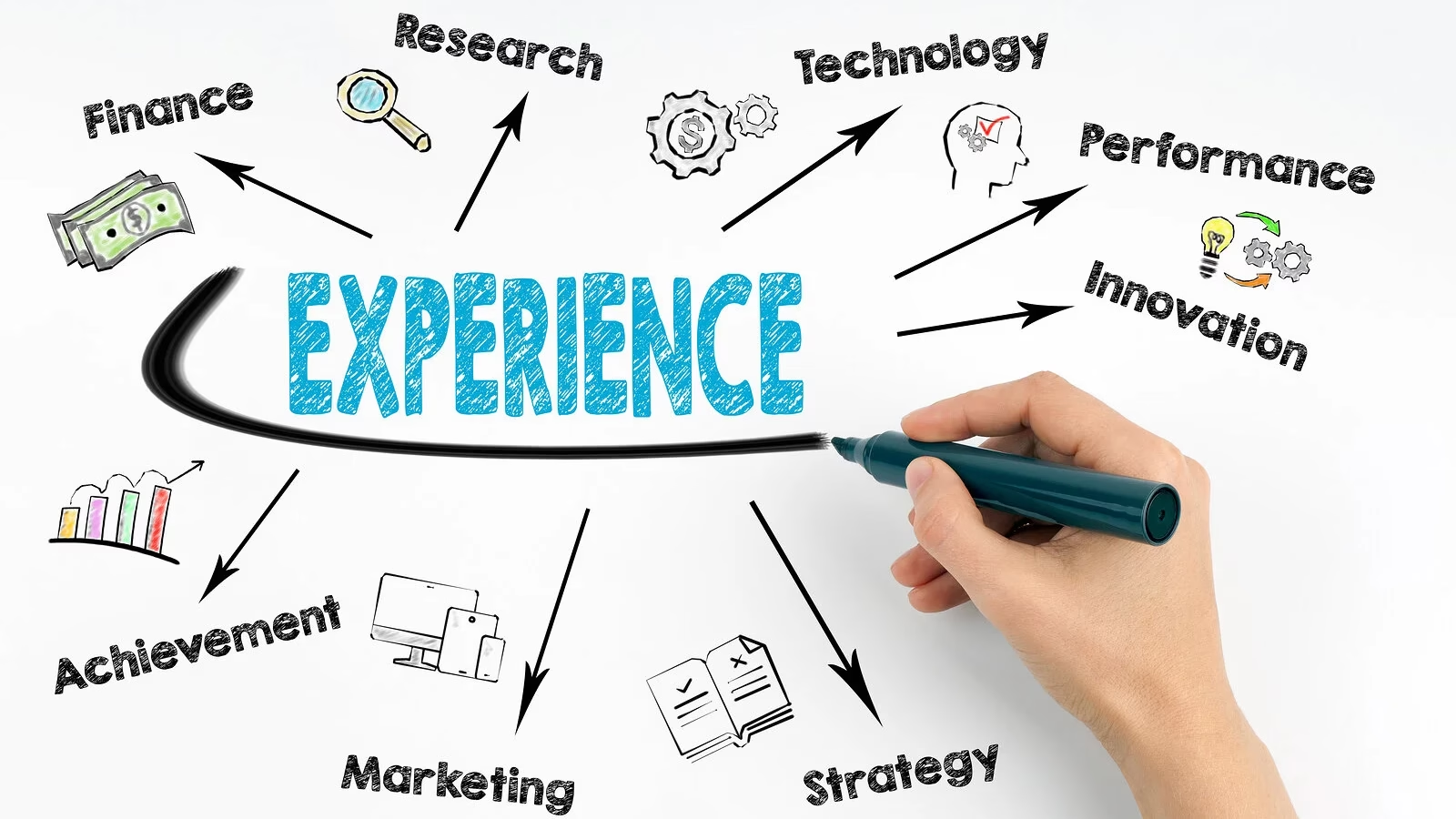
Customer Experience in Business
Customer enjoy directly influences emblem loyalty.
Ways to improve:
- Personalized verbal exchange
- Fast aid
- Quality merchandise
- Transparent regulations
- Feedback collection
Happy customers power repeat commercial enterprise and referrals. Customer enjoy in business refers to the general influence customers have when interacting with a logo across every touchpoint, which include merchandise, offerings, assist and communication. A wonderful consumer experience builds consider, will increase satisfaction, and encourages repeat purchases.
In aggressive markets, businesses that target turning in easy and personalized reviews often benefit a sturdy benefit.
Business Technology Trends
Technology maintains to influence business innovation.
Trending technology:
- Artificial intelligence
- Automation equipment
- Cloud computing
- Data analytics
- No code systems
Adopting these technology improves productiveness and scalability. Business era developments are remodeling how groups operate and compete in the virtual panorama. Innovations consisting of artificial intelligence, automation, cloud computing, facts analytics and no code systems are assisting organizations improve performance, reduce costs and make smarter decisions. These technologies additionally beautify purchaser experiences, allow faraway collaboration and guide faster scaling, making era adoption crucial for cutting edge commercial enterprise increase.
Scaling and Growth Strategies
Scaling business requires strategic making plans.
Growth strategies:
- Market expansion
- Product diversification
- Strategic partnership
- Franchising
- Digital scaling
Sustainable growth makes a speciality of efficiency and profitability. The table below outlines key scaling and growth strategies and their potential impact.
Scaling and Growth Strategies Overview:
| Strategy | Description | Key Activity | Example | Growth Outcome |
|---|---|---|---|---|
| Market Expansion | Entering new geographic or audience markets | Market research | Launch in new region | Increased customer base |
| Product Diversification | Adding new products or services | Product development | New service line | Higher revenue streams |
| Strategic Partnerships | Collaborating with other businesses | Joint ventures | Co-marketing campaign | Brand exposure |
| Automation & Systems | Using tools to improve efficiency | Workflow automation | CRM implementation | Scalable operations |
| Franchising / Licensing | Allowing others to operate under your brand | Franchise model | Franchise outlets | Rapid business expansion |
Future of Business
The future of business will be formed by means of:
- AI-powered automation
- Remote paintings lifestyle
- Creator economic system
- Sustainable commercial enterprise practices
- Global virtual marketplaces
Businesses that innovate and adapt will dominate destiny markets. The future of commercial enterprise might be formed with the aid of speedy technological innovation, converting customer expectations and international digital connectivity. Businesses are shifting closer to automation, data pushed selection making and customized client experiences to live competitive. Emerging tendencies consisting of synthetic intelligence, far flung work models, sustainable practices and the writer economy are redefining conventional enterprise structures.
Companies that embrace innovation, adapt fast to marketplace adjustments, and prioritize patron centric techniques will be higher placed for lengthy time period fulfillment. In the evolving digital landscape, flexibility, non stop gaining knowledge of and strategic use of technology might be key drivers of future commercial enterprise boom.
Conclusion
Business is dynamic, era-pushed and opportunity rich. Whether launching a startup or scaling an current organization, achievement depends on strategy, innovation and client cognizance.
By enforcing the techniques discussed on this manual, entrepreneurs can build resilient, worthwhile and scalable businesses in the evolving virtual economic system.