

Artificial intelligence has moved far beyond being an emerging technology. Today, it is helping businesses automate repetitive tasks, improve customer experiences, analyze massive datasets, strengthen cybersecurity, and make smarter decisions in less time. Companies of every size from startups to global enterprises are investing in AI to stay competitive in an increasingly digital marketplace.
However, buying an AI tool is not the same as building a successful AI-powered organization. Many businesses invest in artificial intelligence without a clear direction, resulting in disconnected systems, low employee adoption, and disappointing returns. This is where a Business AI Strategy becomes essential.
A well-defined strategy provides a roadmap for selecting the right technologies, preparing data, training employees, measuring performance, and scaling AI initiatives across the organization. Instead of experimenting with isolated AI solutions, businesses can create a structured plan that aligns technology investments with long-term business goals.
In this guide, you’ll learn what a Business AI Strategy is, why it matters, the essential building blocks of a successful AI roadmap, and how organizations can prepare for sustainable AI-driven growth.
What Is a Business AI Strategy?
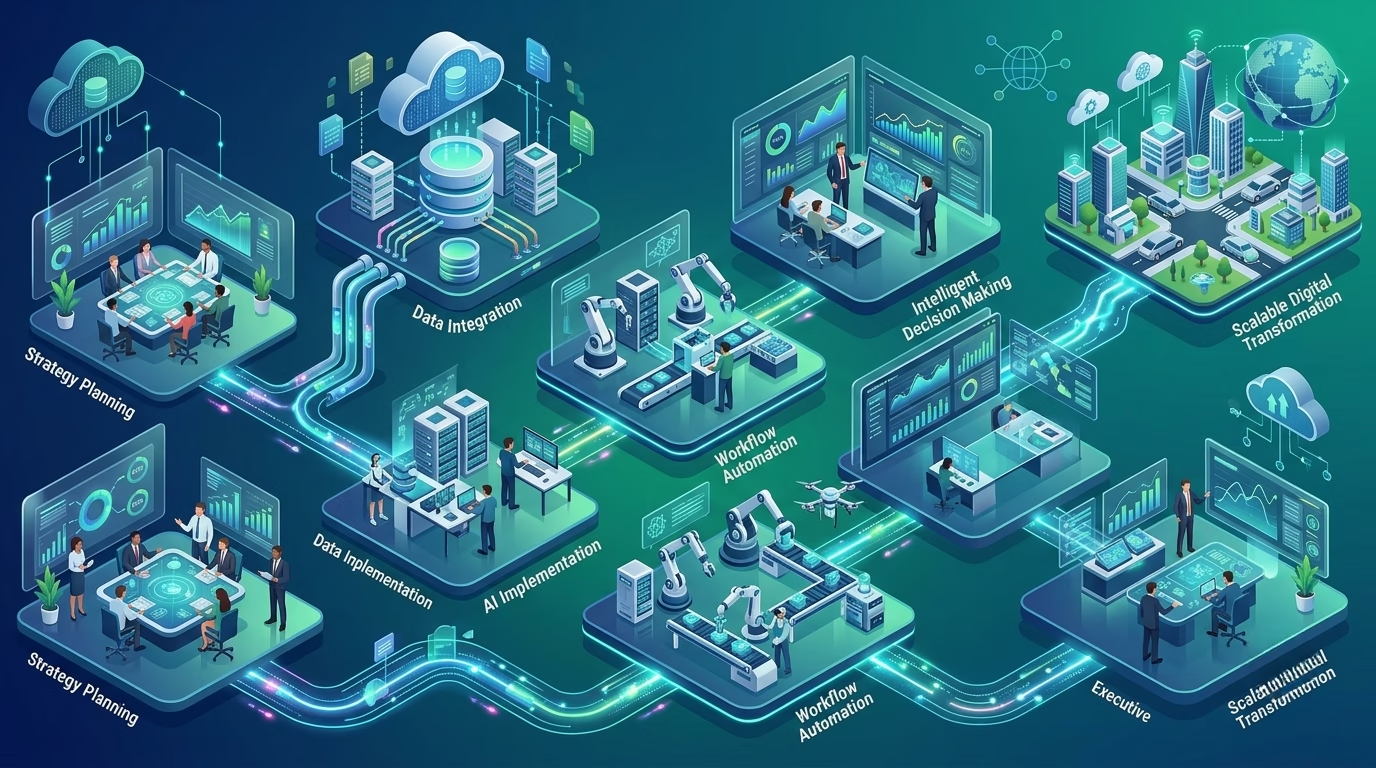
A Business AI Strategy is a structured plan that explains how an organization will adopt, implement, and scale artificial intelligence to achieve measurable business outcomes. It connects AI investments with broader business objectives, ensuring that technology supports growth rather than becoming another isolated software purchase.
Rather than asking, “How can we use AI?”, successful organizations ask, “Which business problems should AI solve first?”
This shift in thinking helps companies focus on practical improvements such as:
- Automating repetitive workflows
- Improving customer service
- Increasing operational efficiency
- Enhancing decision-making with predictive analytics
- Reducing operational costs
- Accelerating product innovation
An effective AI strategy also considers governance, data quality, security, compliance, employee training, and long-term scalability.
Why Every Business Needs an AI Strategy
Artificial intelligence is becoming a competitive advantage across almost every industry. Organizations without a structured AI plan risk falling behind competitors that use automation and intelligent analytics to improve speed, efficiency, and customer satisfaction.
A Business AI Strategy allows companies to:
- Prioritize high-value AI projects
- Reduce implementation risks
- Improve return on investment
- Prepare employees for AI adoption
- Scale AI initiatives across departments
- Make better data-driven decisions
Without a roadmap, businesses often invest in multiple AI tools that do not integrate well, leading to higher costs and fragmented workflows.
Table 1: Businesses With an AI Strategy vs Businesses Without One
| Area | Businesses With an AI Strategy | Businesses Without an AI Strategy |
|---|---|---|
| Decision Making | Data-driven and predictive | Mostly reactive |
| AI Investments | Planned and measurable | Random tool adoption |
| Productivity | Consistent automation | Manual processes remain |
| Employee Adoption | Structured training | Low engagement |
| ROI | Easier to measure | Difficult to justify spending |
| Scalability | High | Limited |
Key Benefits of a Business AI Strategy
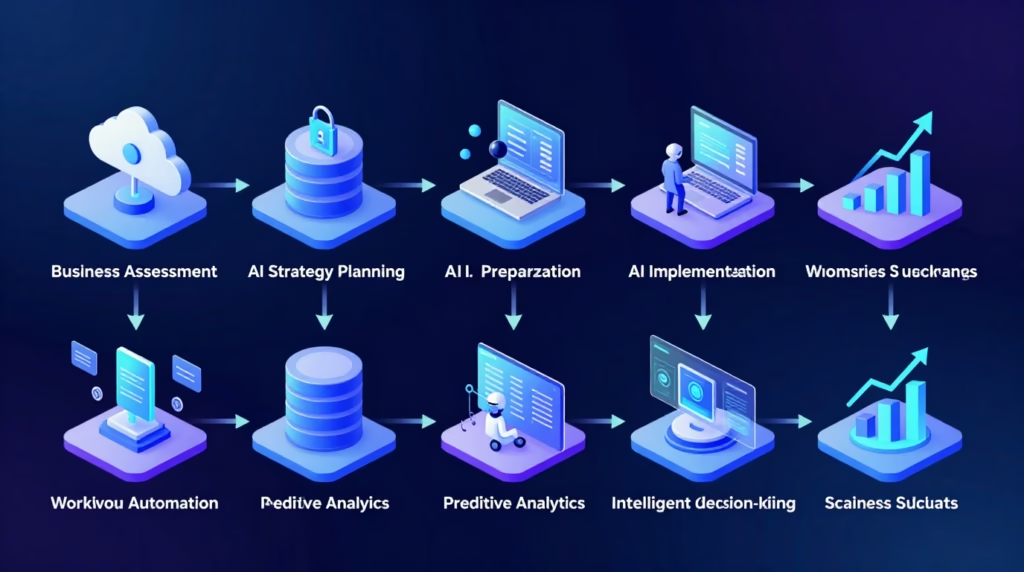
Implementing artificial intelligence with a clear roadmap delivers benefits across every department.
1. Improved Decision-Making
Modern businesses generate enormous amounts of data every day. AI systems can process this information far faster than humans, uncovering patterns that support better strategic decisions.
For example, AI can forecast customer demand, identify sales opportunities, detect operational risks, and recommend actions based on historical trends.
Instead of relying on intuition alone, executives gain access to real-time insights that improve business planning.
2. Higher Operational Efficiency
Many daily business tasks are repetitive and time-consuming. AI helps automate these activities, allowing employees to focus on higher-value work.
Examples include:
- Invoice processing
- Customer support
- Report generation
- Document classification
- Email routing
- Workflow automation
Automation reduces manual errors while increasing productivity.
3. Better Customer Experiences
Today’s customers expect personalized experiences across every interaction.
AI makes this possible by analyzing customer behavior and preferences in real time.
Businesses can use AI to:
- Recommend products
- Personalize marketing campaigns
- Improve customer service
- Predict customer needs
- Reduce response times
As customer expectations continue to rise, AI becomes an important tool for building long-term loyalty.
4. Smarter Resource Allocation
Business leaders often struggle with limited budgets and resources.
AI helps organizations identify where investments will produce the highest returns by analyzing operational performance, workforce utilization, and financial data.
This allows managers to make more informed budgeting decisions.
5. Competitive Advantage
Organizations that successfully integrate AI often innovate faster than competitors.
They can launch products more quickly, respond to market changes sooner, optimize supply chains, and improve customer engagement all while controlling operational costs.
Businesses that delay AI adoption may find it increasingly difficult to compete in digital-first markets.
Table 2: Business Benefits of AI Across Departments
| Department | AI Applications | Business Benefits |
|---|---|---|
| Marketing | Campaign optimization, content generation, customer segmentation | Better ROI and engagement |
| Sales | Lead scoring, sales forecasting, CRM automation | Increased conversions |
| Customer Service | AI chatbots, virtual assistants | Faster support |
| Finance | Fraud detection, expense analysis | Reduced financial risks |
| HR | Resume screening, employee analytics | Faster hiring |
| Operations | Workflow automation, predictive maintenance | Higher efficiency |
| IT | Security monitoring, system optimization | Reduced downtime |
| Supply Chain | Demand forecasting, inventory optimization | Lower operational costs |
Essential Components of a Successful Business AI Strategy
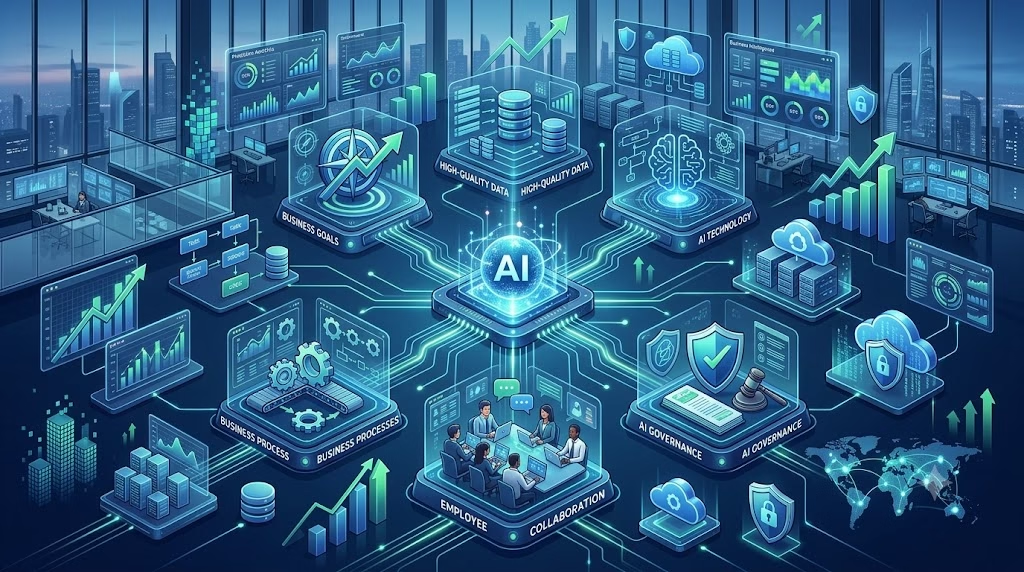
Every successful AI implementation begins with a strong foundation.
Instead of rushing into technology purchases, organizations should focus on five core areas.
Define Clear Business Objectives
AI should always solve a business problem.
Before selecting tools, leaders should identify measurable goals.
Examples include:
- Reduce customer support costs by 30%
- Improve sales forecasting accuracy
- Increase employee productivity
- Shorten product development cycles
- Improve customer retention
Clear objectives help prioritize projects with the highest business value.
Build a Strong Data Foundation
Artificial intelligence depends on high-quality data.
Poor data leads to inaccurate predictions, unreliable recommendations, and ineffective automation.
Organizations should focus on:
- Data accuracy
- Data consistency
- Secure storage
- Data governance
- Regular updates
- Compliance with privacy regulations
Good data is one of the biggest predictors of AI success.
Choose the Right AI Technologies
Not every business requires the same AI capabilities.
Some organizations benefit from predictive analytics, while others need conversational AI, document automation, or computer vision.
Selecting technologies should depend on business objectives rather than market trends.
Common AI technologies include:
- Machine Learning
- Generative AI
- Natural Language Processing
- Computer Vision
- Predictive Analytics
- Intelligent Automation
- AI Agents
Invest in Employee Skills
Technology alone does not create transformation.
Employees must understand how AI supports their work rather than replacing it.
Successful organizations provide:
- AI awareness programs
- Technical training
- Change management initiatives
- Cross-functional collaboration
- Continuous learning opportunities
Businesses that invest in people often achieve stronger AI adoption rates.
Create an AI Governance Framework
Responsible AI requires clear policies.
Organizations should define:
- Data privacy standards
- Security controls
- Ethical AI guidelines
- Human oversight
- Risk management processes
- Compliance requirements
Governance ensures AI systems remain transparent, secure, and aligned with organizational values.
Is Your Business Ready for AI?
Before launching an AI initiative, companies should evaluate their current readiness.
The following checklist helps identify strengths and gaps.
Table 3: AI Readiness Assessment
| Assessment Area | Questions to Consider |
|---|---|
| Business Goals | Are AI objectives aligned with business priorities? |
| Data | Is business data accurate, accessible, and organized? |
| Technology | Does existing infrastructure support AI workloads? |
| Leadership | Is executive leadership committed to AI adoption? |
| Employees | Do teams have the necessary AI skills? |
| Security | Are cybersecurity policies prepared for AI systems? |
| Budget | Is funding available for implementation and scaling? |
| Governance | Are ethical and compliance policies established? |
Organizations that can confidently answer “Yes” to most of these questions are typically better positioned to implement AI successfully.
Why a Long-Term AI Roadmap Matters
- Many businesses begin their AI journey with a single chatbot or automation tool. While these projects can deliver quick wins, long-term success comes from thinking beyond isolated solutions.
- A strategic AI roadmap helps organizations move from experimentation to enterprise-wide transformation. It creates a phased approach where each AI initiative builds on previous successes, reducing risk while maximizing value.
- Businesses with a clear roadmap are better equipped to adapt as AI technologies evolve. They can integrate new capabilities, scale successful projects, and ensure every AI investment supports broader business objectives.
- In the next section, we’ll explore how to build a step-by-step AI implementation roadmap, choose the right technology stack, measure ROI, avoid common implementation mistakes, and examine real-world AI use cases across industries.
Business AI Strategy: The Complete AI Roadmap for Growth (Part 2)
- In the first part of this guide, we explored why a Business AI Strategy has become essential for organizations looking to remain competitive in an increasingly digital economy. We also discussed the importance of AI readiness, leadership commitment, data quality, and governance. However, having a strategy on paper is only the beginning. The real challenge lies in transforming that strategy into practical business outcomes.
- Many organizations invest heavily in artificial intelligence but struggle to generate meaningful returns because they lack a structured implementation plan. They often introduce AI tools without preparing their workforce, cleaning their data, or defining measurable business objectives.
- As a result, projects become isolated experiments rather than enterprise-wide transformation initiatives. A successful Business AI Strategy follows a clear roadmap that gradually expands AI capabilities while minimizing operational risks and maximizing business value.
Building a Step-by-Step AI Implementation Roadmap
- Artificial intelligence should never be viewed as a single technology project. Instead, it should be treated as a long-term business transformation program that evolves alongside organizational goals. Every business has different priorities, operational challenges, and customer expectations, which means there is no universal implementation model.
- The most successful companies begin with smaller, high-impact initiatives that solve immediate business problems before expanding AI across multiple departments.
- A structured roadmap helps organizations avoid common implementation mistakes by ensuring that every AI investment contributes directly to measurable business outcomes. Rather than deploying AI across the entire organization at once, businesses should adopt a phased approach that allows teams to learn, improve, and scale gradually. This approach also reduces financial risk while increasing employee confidence in new technologies.
- The implementation journey generally begins with understanding business challenges, identifying suitable AI use cases, preparing reliable data, selecting the appropriate technology, conducting pilot projects, measuring outcomes, and finally scaling successful initiatives throughout the organization.
Table 4: Recommended AI Implementation Roadmap
| Phase | Primary Objective | Expected Outcome |
|---|---|---|
| Business Assessment | Identify business problems | Clear AI opportunities |
| Data Preparation | Organize and clean business data | Reliable AI models |
| Technology Selection | Choose AI platforms and tools | Scalable infrastructure |
| Pilot Implementation | Test AI in one department | Lower implementation risk |
| Performance Evaluation | Measure business impact | Data-driven improvements |
| Enterprise Scaling | Expand AI across departments | Long-term business growth |
Following these phases creates a strong foundation for sustainable AI adoption rather than isolated technology deployments.
Identifying High-Value AI Opportunities
- One of the most important decisions organizations make is determining where AI should be implemented first. Businesses often assume that artificial intelligence should replace as many manual processes as possible. In reality, the highest returns usually come from solving a few critical business problems exceptionally well before expanding into other areas.
- Leaders should begin by examining repetitive workflows, operational bottlenecks, customer pain points, and areas where employees spend significant time performing manual tasks. AI delivers the greatest value when it automates repetitive activities, enhances decision-making, or improves customer experiences without disrupting existing operations.
- For example, customer service teams frequently spend hours answering similar questions. Marketing departments manually analyze campaign performance across multiple platforms. Finance teams review thousands of invoices every month, while HR professionals screen hundreds of resumes for each hiring cycle. These repetitive tasks provide excellent opportunities for AI implementation because they consume valuable employee time while offering relatively predictable workflows.
- Organizations should prioritize projects that can demonstrate measurable improvements within a reasonable timeframe. Early successes not only improve return on investment but also encourage employees and leadership to support larger AI initiatives.
Preparing Data for Successful AI Adoption
- Data is often described as the fuel that powers artificial intelligence. Regardless of how advanced an AI platform may be, poor-quality data limits its effectiveness. Organizations with incomplete, inconsistent, or outdated information often experience inaccurate predictions and unreliable automation results.
- Before implementing AI, businesses should evaluate how data is collected, stored, managed, and shared across departments. Many organizations discover that valuable information is scattered across different software platforms, making it difficult for AI systems to access complete datasets. Creating centralized data repositories and establishing consistent data governance policies significantly improves AI performance.
- Data preparation also involves removing duplicate records, correcting inaccuracies, standardizing formats, and ensuring compliance with privacy regulations. Businesses that invest time in improving data quality usually experience stronger AI outcomes and more accurate business insights.
Table 5: Data Readiness Checklist for AI Projects
| Data Requirement | Why It Matters |
|---|---|
| Accurate Data | Improves prediction quality |
| Consistent Formatting | Reduces processing errors |
| Secure Storage | Protects sensitive information |
| Data Governance | Maintains compliance |
| Regular Updates | Keeps AI recommendations relevant |
| Centralized Access | Enables cross-department collaboration |
| Backup and Recovery | Prevents data loss |
| Privacy Compliance | Meets legal and regulatory requirements |
Organizations that treat data as a strategic business asset are better positioned to maximize the value of artificial intelligence.
Choosing the Right AI Technologies
- Selecting AI technology requires careful evaluation of business objectives rather than following market trends. Every organization has different operational requirements, customer expectations, and technology environments. The most successful AI strategies focus on solving specific business challenges instead of implementing every available AI capability.
- For instance, companies focused on improving customer engagement may benefit from conversational AI and recommendation engines, while manufacturers often prioritize predictive maintenance and computer vision. Financial institutions typically invest in fraud detection, intelligent document processing, and predictive analytics to strengthen risk management.
- Another important consideration is integration. AI solutions should work seamlessly with existing CRM systems, ERP platforms, cloud infrastructure, and business intelligence tools. Poor integration often creates isolated workflows that reduce efficiency rather than improving it.
- Business leaders should also evaluate scalability, vendor support, implementation costs, security features, and long-term flexibility before selecting an AI platform. Investing in technologies that can grow alongside the business prevents unnecessary system replacements in the future.
Table 6: AI Technologies and Their Business Applications
| AI Technology | Common Business Applications | Primary Benefit |
|---|---|---|
| Machine Learning | Forecasting, demand prediction | Better business decisions |
| Generative AI | Content creation, document drafting | Increased productivity |
| Natural Language Processing | Chatbots, sentiment analysis | Improved customer experience |
| Computer Vision | Manufacturing inspection | Higher product quality |
| Predictive Analytics | Sales forecasting | Better planning |
| Intelligent Automation | Workflow automation | Reduced manual effort |
| AI Agents | Multi-step business tasks | End-to-end automation |
| Recommendation Engines | Product recommendations | Increased sales |
Launching Pilot Projects Before Enterprise Expansion
- One of the biggest reasons AI projects fail is attempting organization-wide deployment too quickly. Successful businesses understand that AI should be introduced gradually through carefully planned pilot projects.
- These smaller initiatives allow organizations to evaluate technology performance, identify operational challenges, and collect employee feedback before committing to larger investments.
- A pilot project should focus on one department or business process with clearly defined objectives and measurable success metrics. For example, a customer service team might introduce an AI-powered chatbot to handle frequently asked questions.
- Marketing departments may begin with AI-assisted campaign optimization, while finance teams could automate invoice processing.
- During the pilot phase, organizations should continuously monitor performance indicators such as cost savings, employee productivity, response times, customer satisfaction, and error rates. These insights help refine workflows and build confidence for future AI expansion.
- Pilot programs also play an important role in change management. Employees become familiar with AI capabilities, understand how the technology supports their daily work, and develop greater trust in AI-driven processes.
Once a pilot consistently delivers measurable value, organizations can confidently extend similar solutions to other business functions.
Measuring AI Success Through Business Outcomes
- The success of artificial intelligence should never be measured solely by technical performance. While model accuracy and processing speed are important, executives are primarily interested in business outcomes.
- Every AI initiative should contribute to broader organizational objectives such as revenue growth, operational efficiency, customer satisfaction, or cost reduction.
- Businesses should establish Key Performance Indicators (KPIs) before implementation begins. This makes it easier to evaluate whether AI investments are delivering the expected return. For example, an AI-powered customer service solution may aim to reduce response times by 40%, while a predictive analytics platform could improve sales forecast accuracy by 25%.
- Monitoring these metrics regularly enables organizations to identify areas for improvement, optimize AI models, and justify future investments. Continuous evaluation also ensures that AI remains aligned with changing business priorities rather than becoming a static technology project.
Table 7: Key Performance Indicators for AI Success
| KPI | Business Impact |
|---|---|
| Revenue Growth | Measures increased sales opportunities |
| Customer Satisfaction | Reflects improved customer experiences |
| Productivity | Tracks operational efficiency |
| Cost Reduction | Indicates savings through automation |
| Forecast Accuracy | Supports better strategic planning |
| Customer Retention | Measures long-term loyalty |
| Employee Efficiency | Evaluates reduction in manual work |
| Error Rate | Assesses process quality and accuracy |
Common Challenges During AI Implementation
Although artificial intelligence offers tremendous opportunities, businesses should also prepare for implementation challenges. One of the most common issues is resistance to change. Employees may worry that AI will replace their jobs rather than enhance their productivity. Transparent communication, continuous training, and involving employees in the implementation process can significantly reduce these concerns.
Another challenge involves integrating AI with legacy business systems. Older software may not support modern AI platforms, requiring additional investments in infrastructure and data migration. Organizations should carefully assess their technology environment before beginning implementation.
Data privacy and cybersecurity also require ongoing attention. AI systems frequently process sensitive customer information, making strong governance, access controls, encryption, and regulatory compliance essential components of every Business AI Strategy.
Finally, businesses should avoid expecting immediate transformation. AI adoption is a continuous journey that evolves through experimentation, learning, optimization, and gradual expansion. Organizations that remain patient and committed to long-term improvement typically achieve far greater results than those seeking quick technological fixes.
The Future of Business AI Strategy
Artificial intelligence is entering a new phase where it moves beyond automation and begins acting as a collaborative business partner. Earlier AI systems were designed to perform specific tasks, such as analyzing data, recognizing images, or answering customer questions. Today’s AI technologies are becoming more adaptive, capable of understanding complex workflows, learning from interactions, and assisting employees across multiple business functions.
Over the next several years, businesses will increasingly rely on AI to support strategic planning, optimize operations, and create highly personalized customer experiences. Rather than replacing human expertise, AI will augment decision-making by processing vast amounts of information in real time and presenting actionable insights. This shift will allow leaders to respond faster to market changes, identify new growth opportunities, and make more informed business decisions.
Organizations that invest in AI today are also laying the foundation for future innovations such as autonomous business processes, predictive decision-making, intelligent supply chains, and AI-driven product development. Companies that fail to prepare may struggle to compete with businesses that can adapt more quickly to changing customer expectations and market conditions.
Emerging Trends Shaping Business AI Strategy
Artificial intelligence continues to evolve rapidly, creating new opportunities for businesses across every industry. Understanding these emerging trends helps organizations prepare for the next phase of digital transformation while making informed investment decisions.
AI Agents Will Transform Business Operations
One of the most significant developments is the rise of AI agents. Unlike traditional automation tools that perform a single predefined task, AI agents can complete complex, multi-step workflows with minimal human intervention. They can analyze information, make recommendations, communicate with software systems, and execute business processes across multiple applications.
For example, an AI sales agent may identify potential leads, research customer information, draft personalized emails, schedule meetings, update CRM records, and generate follow-up reports without requiring constant supervision. This level of automation allows employees to focus on higher-value strategic activities instead of repetitive administrative work.
As AI agents become more sophisticated, businesses will increasingly use them in customer support, finance, human resources, procurement, project management, and supply chain operations.
Hyper-Personalization Will Become the Standard
Modern consumers expect businesses to understand their preferences and provide personalized experiences. Artificial intelligence enables organizations to analyze customer behavior, purchasing patterns, browsing history, and engagement data to deliver highly relevant recommendations and communications.
Instead of creating broad marketing campaigns for large audiences, businesses can develop personalized experiences for individual customers. AI can recommend products, adjust pricing strategies, deliver customized content, and predict future customer needs based on historical interactions.
Organizations that embrace AI-powered personalization are likely to strengthen customer relationships, improve satisfaction, and increase long-term loyalty.
Predictive Analytics Will Drive Smarter Decisions
Business leaders increasingly rely on predictive analytics to anticipate market trends, customer demand, and operational risks. Rather than reacting to events after they occur, organizations can use AI to forecast future outcomes and make proactive decisions.
Retail companies can predict seasonal demand, manufacturers can anticipate equipment failures, healthcare providers can identify high-risk patients, and financial institutions can detect fraudulent transactions before significant damage occurs.
As predictive models become more accurate, businesses will make faster and more confident decisions supported by data rather than intuition alone.
Table 8: Future AI Trends and Business Impact
| Emerging Trend | Business Impact |
|---|---|
| AI Agents | Automates complex workflows across departments |
| Generative AI | Accelerates content creation and knowledge management |
| Predictive Analytics | Improves forecasting and planning |
| Intelligent Automation | Reduces repetitive manual tasks |
| AI-Powered Cybersecurity | Detects threats faster and improves resilience |
| Hyper-Personalization | Enhances customer engagement and loyalty |
| Explainable AI | Builds trust through transparent decision-making |
| AI Governance | Ensures responsible and compliant AI adoption |
Businesses that monitor these trends can adapt more quickly and maintain a competitive advantage.
Challenges Businesses Must Prepare For
While artificial intelligence offers remarkable opportunities, successful implementation also requires organizations to address several important challenges. Recognizing these obstacles early enables businesses to develop strategies that reduce risks and improve long-term success.
Data Privacy and Security
AI systems rely on large volumes of business and customer data. Protecting this information has become one of the highest priorities for organizations adopting AI. Businesses must implement strong cybersecurity measures, encrypt sensitive information, monitor system access, and comply with data privacy regulations.
Failure to secure AI systems can expose organizations to financial losses, regulatory penalties, and reputational damage. As AI adoption grows, cybersecurity should remain an integral part of every Business AI Strategy rather than an afterthought.
Employee Adoption and Change Management
Technology transformation succeeds only when employees understand and embrace new ways of working. Some employees may worry that AI will replace their jobs, while others may struggle to adapt to unfamiliar technologies.
Organizations should communicate clearly about the purpose of AI, provide practical training, and demonstrate how AI enhances rather than replaces human expertise. Encouraging collaboration between employees and AI systems creates a more positive adoption experience and increases long-term productivity.
Integration with Existing Systems
Many organizations operate on legacy software that was not designed for modern AI technologies. Integrating AI into existing CRM, ERP, accounting, and operational systems can be technically challenging and may require infrastructure upgrades.
Planning integration carefully before implementation reduces disruption and ensures AI delivers consistent value across the organization.
Ethical AI and Responsible Decision-Making
Businesses must also consider ethical issues such as bias, fairness, transparency, and accountability. AI systems should support responsible decision-making while maintaining human oversight for critical business processes.
Developing clear AI governance policies helps organizations use artificial intelligence responsibly and maintain customer trust.
Table 9: Common AI Challenges and Recommended Solutions
| Challenge | Recommended Solution |
|---|---|
| Poor Data Quality | Implement data governance and regular data cleaning |
| Employee Resistance | Provide AI training and transparent communication |
| Security Risks | Strengthen cybersecurity and access controls |
| Legacy Systems | Modernize infrastructure and integrate gradually |
| High Initial Costs | Begin with pilot projects and scale progressively |
| Ethical Concerns | Establish AI governance policies and human oversight |
Addressing these challenges early improves implementation success while reducing long-term operational risks.
Best Practices for a Successful Business AI Strategy
Organizations that achieve the greatest value from artificial intelligence generally follow a consistent set of best practices. These principles help ensure AI investments remain aligned with business objectives while supporting sustainable growth.
Businesses should begin with clearly defined goals rather than adopting AI simply because competitors are doing so. Every project should solve a measurable business problem and contribute directly to strategic priorities. Maintaining strong data quality is equally important, as reliable information enables AI systems to produce accurate recommendations and meaningful insights.
Leaders should encourage continuous learning by investing in employee training and creating opportunities for teams to develop AI-related skills. Building cross-functional collaboration between business units, IT teams, and leadership also improves implementation outcomes by ensuring that AI initiatives reflect real business needs.
Finally, organizations should treat AI as an ongoing journey rather than a one-time technology investment. Regular performance reviews, model improvements, and adaptation to emerging technologies help businesses remain competitive as artificial intelligence continues to evolve.
Table 10: Best Practices for Long-Term AI Success
| Best Practice | Business Benefit |
|---|---|
| Align AI with Business Goals | Higher return on investment |
| Improve Data Quality | Better AI accuracy |
| Train Employees | Faster adoption |
| Monitor Performance | Continuous improvement |
| Strengthen AI Governance | Responsible AI usage |
| Scale Gradually | Reduced implementation risk |
| Measure ROI Regularly | Better investment decisions |
| Encourage Innovation | Long-term competitive advantage |
Conclusion
Artificial intelligence has become one of the most transformative technologies shaping modern business. However, the organizations that achieve the greatest success are not necessarily those investing the most money in AI. Instead, they are the businesses that approach AI with a clear strategy, realistic expectations, and a commitment to continuous improvement.
A well-designed Business AI Strategy provides a roadmap that connects technology investments with measurable business outcomes. It helps organizations identify high-value opportunities, prepare reliable data, choose appropriate technologies, train employees, measure performance, and scale AI initiatives responsibly. By following a structured implementation approach, businesses can reduce risks while unlocking significant improvements in productivity, customer experience, innovation, and operational efficiency.
As artificial intelligence continues to evolve through AI agents, predictive analytics, intelligent automation, and personalized customer experiences, businesses that remain proactive will be better positioned to adapt to changing market conditions and maintain a lasting competitive advantage. AI should not be viewed as a replacement for human expertise but as a powerful partner that enhances decision-making and supports sustainable growth.
Organizations that begin building a strong Business AI Strategy today will be better prepared for tomorrow’s opportunities, enabling them to innovate faster, respond more effectively to customer needs, and thrive in an increasingly AI-driven economy.
Frequently Asked Questions (FAQs)
1. What is a Business AI Strategy?
A Business AI Strategy is a structured plan that outlines how an organization will adopt, implement, and scale artificial intelligence to achieve measurable business goals such as improving efficiency, reducing costs, and enhancing customer experiences.
2. Why is a Business AI Strategy important?
It ensures that AI investments align with business objectives, reduce implementation risks, improve employee adoption, and deliver measurable return on investment.
3. How can small businesses benefit from AI?
Small businesses can automate customer support, improve marketing campaigns, analyze sales data, streamline administrative tasks, and enhance customer engagement without requiring large technology teams.
4. What are the first steps in implementing AI?
Businesses should identify key challenges, evaluate data readiness, define measurable objectives, select appropriate AI technologies, and begin with small pilot projects before expanding across the organization.
5. Which industries benefit the most from AI?
Healthcare, finance, manufacturing, retail, logistics, education, marketing, telecommunications, and professional services all benefit significantly from AI-powered automation and analytics.
6. What is the biggest challenge in AI adoption?
The most common challenges include poor data quality, employee resistance, integration with existing systems, cybersecurity concerns, and maintaining ethical AI practices.